


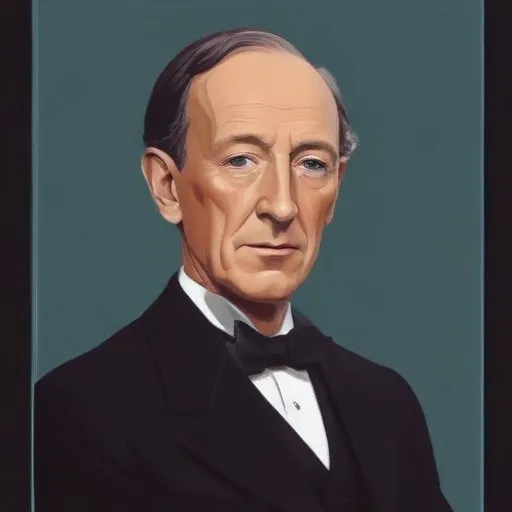
Discovered neutrons, a fundamental particle in atomic nuclei, revolutionizing our understanding of the atom.
Sir James Chadwick, a renowned English physicist, etched his name in the annals of history with his groundbreaking discovery of the neutron in 1932, earning him the prestigious Nobel Prize in Physics in 1935. This pioneering feat not only revolutionized the understanding of atomic structure but also paved the way for the development of atomic bombs during World War II.
Born on October 20, 1891, in Bollington, Cheshire, England, Chadwick was drawn to the world of physics at a young age. He pursued his passion at the Victoria University of Manchester, where he studied under the guidance of Ernest Rutherford, the father of nuclear physics. Chadwick's academic excellence earned him an MSc in 1913 and an 1851 Research Fellowship from the Royal Commission for the Exhibition of 1851.
Chadwick's most notable contribution to the field of physics was the discovery of the neutron. Using a novel technique, he demonstrated the existence of this neutral particle, which was previously unknown. This breakthrough discovery not only confirmed the existence of neutrons but also opened up new avenues for research in nuclear physics.
Chadwick's work took a dramatic turn during World War II. In 1941, he authored the final draft of the MAUD Report, which persuaded the U.S. government to iniciar serious atom bomb research efforts. As the head of the British team, Chadwick played a pivotal role in the Manhattan Project, working alongside American scientists to develop the atomic bomb.
In recognition of his outstanding contributions to physics, Chadwick was knighted in 1945. He held esteemed positions, including professor of physics at the University of Liverpool and director of the Cavendish Laboratory at the University of Cambridge. Throughout his illustrious career, Chadwick received numerous honors and awards, cementing his status as a pioneering figure in the world of physics.
Chadwick's personal life was marked by significant milestones, including his marriage to Aileen Stewart-Brown in 1924 and the birth of their twin daughters in 1927. Despite the demands of his work, Chadwick maintained a strong family bond, and his daughters went on to pursue successful careers in science and medicine.
Chadwick's work extended beyond scientific discovery, as he was deeply committed to the responsible use of scientific knowledge. He emphasized the importance of nuclear energy for peaceful purposes and advocated for international cooperation to prevent the misuse of atomic power.
Sir James Chadwick's legacy extends far beyond the boundaries of the scientific community. His discovery of the neutron and contributions to the development of atomic energy have had a profound impact on modern society, shaping the course of history and inspiring future generations of scientists and thinkers.
Sir James Chadwick passed away on July 24, 1974, leaving behind a rich legacy of scientific discoveries, philosophical contributions, and a lasting impact on modern society. His pioneering work continues to inspire generations of scientists, thinkers, and scholars, ensuring his place as one of the most influential figures in the history of physics.
Born in 1871
A pioneer in nuclear physics, he discovered the nucleus of an atom and developed the Rutherford model, revolutionizing our understanding of the atomic structure.
Born in 1885
A pioneer in quantum mechanics, he introduced the concept of wave-particle duality, revolutionizing our understanding of atomic structure. His philosophical approach to science also explored the nature of reality and human understanding.
Born in 1879
A brilliant physicist who developed the theory of relativity and is considered one of the most influential scientists of the 20th century, known for his groundbreaking work in physics and mathematics.
Born in 1901
A pioneer in quantum mechanics, he formulated the uncertainty principle, which revolutionized our understanding of the atomic world. His groundbreaking work reshaped modern physics.
Born in 1901
A pioneer in nuclear physics, known for leading the team that developed the first nuclear reactor and playing a crucial role in the development of the atomic bomb.
Born in 1898
A pioneer in nuclear physics, known for conceiving the idea of a nuclear chain reaction and patenting the concept of a nuclear reactor. He also played a key role in persuading Einstein to warn Roosevelt about the possibility of Germany developing an atomic bomb.
Born in 1879
A pioneering nuclear chemist who discovered nuclear fission, a process that releases massive energy from atomic nuclei, and was awarded the Nobel Prize in Chemistry in 1944.
Born in 1878
Pioneering physicist who made groundbreaking contributions to nuclear physics, including the discovery of nuclear fission, and was the first woman to become a full professor of physics in Germany.
