


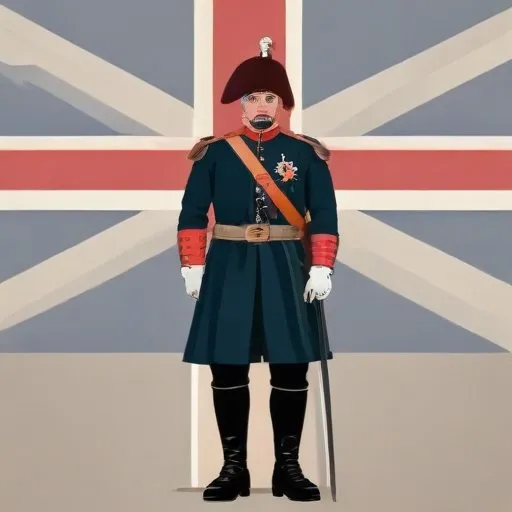
A Scottish soldier who led royalist forces during the English Civil War, known for his bravery and tactical genius, earning him a legendary status in Scottish history.
James Graham, 1st Marquess of Montrose, was a Scottish nobleman, poet, soldier, and statesman who left an indelible mark on the annals of history. He is renowned for his unwavering loyalty to King Charles I, his bravery in the Wars of the Three Kingdoms, and his tactical genius on the battlefield, earning him the epithet "The Great Montrose."
James Graham was born in 1612, the youngest of six children and the only son of John Graham, 4th Earl of Montrose, and Lady Margaret Ruthven. His maternal grandparents were William Ruthven, 1st Earl of Gowrie, and Dorothea Stewart, a daughter of Henry Stewart, 1st Lord Methven.
Graham studied at the College of Glasgow under William Forrett, where he developed a passion for classical literature, particularly the works of Xenophon and Seneca. He later attended Saint Salvators College at the University of St Andrews, where he honed his skills in politics and statecraft.
In 1626, Graham inherited the title of 5th Earl of Montrose upon his father's death. He soon became embroiled in the tumultuous politics of Scotland, initially supporting the Covenanters in the Wars of the Three Kingdoms. However, as the English Civil War unfolded, Graham's allegiance shifted to King Charles I, whom he saw as the rightful ruler of England and Scotland.
From 1644 to 1646, and again in 1650, Graham fought in the civil war in Scotland on behalf of the King, earning recognition for his bravery, strategic prowess, and unwavering loyalty. His military campaigns, though ultimately unsuccessful, are still studied by historians and military strategists for their innovative tactics and genius.
In 1650, Graham was captured at the Battle of Carbisdale and put on trial by the Scottish Parliament. He was sentenced to death by hanging, followed by beheading and quartering. However, after the Restoration, King Charles II posthumously rehabilitated Graham's reputation, recognizing him as a heroic martyr and a symbol of loyalty.
In 1661, Charles II paid for a lavish funeral, reburial, and memorialization of Graham, cementing his status as a romantic hero and inspiring literary works by Walter Scott and John Buchan.
Graham's legacy extends beyond his military campaigns and poetic endeavors. His unwavering commitment to his principles, even in the face of overwhelming adversity, has inspired generations of Scots and Britons alike. His story serves as a testament to the power of loyalty, honor, and bravery in the face of uncertainty and chaos.
In conclusion, James Graham, 1st Marquess of Montrose, was a complex, multifaceted figure whose bravery, loyalty, and strategic genius continue to inspire and fascinate us to this day.
Born in 1630
The last monarch of the House of Stuart, restored to the throne after a republican Commonwealth, known for his lavish spending, mistresses, and the Great Fire of London. He ruled with a mix of absolutism and indulgence, shaping England's Restoration era.
Born in 1599
Leader of the Parliamentarian forces during the English Civil War, who later ruled England, Scotland, and Ireland as a republican dictator, known for his military victories and radical reforms.
Born in 1274
Led Scotland during the First War of Scottish Independence, ultimately securing a decisive victory at the Battle of Bannockburn and earning recognition as the country's rightful king. He's celebrated for his bravery, strategic thinking, and unwavering commitment to Scottish freedom.
Born in 1542
The last Scottish monarch of the House of Stuart, she was a Catholic queen who faced Protestant rebellion and was eventually beheaded, sparking a centuries-long rivalry with England. She's known for her tumultuous reign and tragic fate.
