


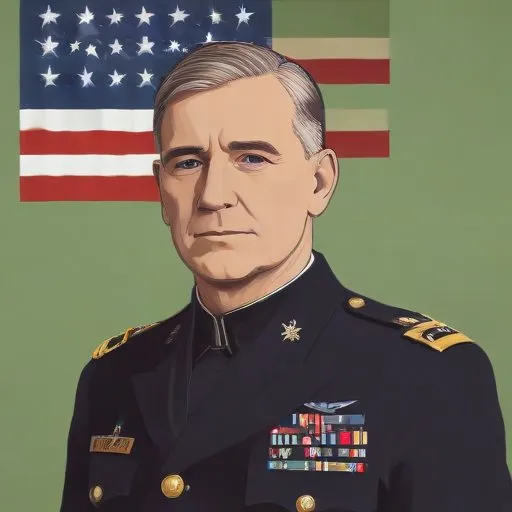
Union general during the American Civil War, known for his bravery and leadership at the Battle of Stones River. He later became a prominent figure in the Grand Army of the Republic.
James McCormack Jr. was a trailblazing United States Army officer who made significant contributions to the development of nuclear energy, serving as the first Director of Military Applications of the United States Atomic Energy Commission. As a key figure in the nuclear age, McCormack played a crucial role in shaping the course of nuclear research and development in the United States.
McCormack was born on November 8, 1910, and graduated from the United States Military Academy at West Point in 1932. He went on to study at Hertford College, Oxford, as a Rhodes Scholar, earning a Master of Arts degree in Romance languages. He furthered his education at the Massachusetts Institute of Technology (MIT), where he earned a Master of Science degree in civil engineering.
McCormack's military career spanned over two decades, during which he served in various capacities. In 1942, he was assigned to the War Department General Staff, and later became the Chief of the Movements Branch of the Twelfth United States Army Group. After the war, he returned to the War Department General Staff, where he served in the Operations and Plans Division.
In 1947, McCormack was appointed as the Director of Military Applications of the United States Atomic Energy Commission, with the rank of brigadier general. During his tenure, he took a pragmatic approach to handling the issue of nuclear weapons stockpile custody and supported the development of thermonuclear weapons by Edward Teller.
In 1950, McCormack transferred to the United States Air Force and was appointed Director of Nuclear Applications at the Air Research and Development Center in Baltimore, Maryland. He was later promoted to major general and became the Deputy Commander of the Air Research and Development Command. After retiring from the Air Force in 1955, McCormack became the first head of the Institute for Defense Analysis, a nonprofit research organization created to provide advice and support to the Department of Defense's scientific and technological research efforts.
In 1958, McCormack became vice president for industrial and governmental relations at MIT, where he originated the proposal to use the National Advisory Committee for Aeronautics. Throughout his career, McCormack was known for his vision, leadership, and commitment to advancing nuclear research and development.
James McCormack's contributions to the nuclear age have had a lasting impact on modern society. His leadership and vision helped shape the course of nuclear research and development in the United States. As a pioneer in the field, McCormack's legacy continues to inspire future generations of scientists, engineers, and policymakers.
Born in 1890
Led the Allied forces to victory in World War II and later served as President, maintaining peace and prosperity during the Cold War era. He's known for his strategic leadership and diplomatic skills.
Born in 1885
A renowned military leader who played a crucial role in World War II, particularly in the Allied victory in Europe, known for his bold tactics and unapologetic style.
Born in 1893
Led the US Army in World War II and became the last five-star general, playing a crucial role in shaping post-war American military strategy. He's also known for his humble and unassuming leadership style.
Born in 1880
A highly decorated war hero and master strategist who led troops to victory in World War I and II, and later became a prominent figure in the occupation of Japan.
Born in 1885
Led the U.S. Pacific Fleet to victory in World War II, playing a crucial role in defeating Japan and ending the war. He was a highly respected and decorated naval leader.
Born in 1886
Led the United States Army Air Forces during World War II, playing a crucial role in the Allied victory, and later became the first General of the Air Force. He's also known as the "Father of the US Air Force".
Born in 1880
A highly decorated military leader and statesman who played a crucial role in shaping post-WWII foreign policy and was awarded the Nobel Peace Prize for his efforts. He's most known for authoring the Marshall Plan, a massive economic aid program that helped rebuild war-torn Europe.
