


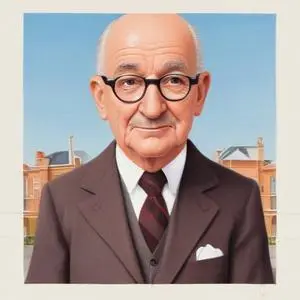
A renowned architect celebrated for designing iconic buildings that blend modernity with historical context, such as the Staatsgalerie Stuttgart and Seeley Historical Library.
James Stirling, a British architect, is renowned for his innovative and provocative designs that revolutionized the Brutalist movement in the mid-20th century. His bold, geometric, and often provocative structures continue to inspire architects, designers, and artists to this day.
Born in Glasgow, Scotland, in 1926, Stirling's family relocated to Liverpool when he was an infant. He attended Quarry Bank High School and later studied architecture at the University of Liverpool from 1945 to 1950, where he was tutored by the esteemed Colin Rowe.
After completing his studies, Stirling worked in various firms in London, including Lyons, Israel, Ellis, where he met his future partner, James Gowan. During this period, he was exposed to the influences of prominent architects such as Alan Colquhoun, John Miller, Neave Brown, and Richard MacCormac, who would later become prominent figures in the architectural world.
In 1956, Stirling and Gowan left Lyons, Israel, Ellis to establish their own practice, Stirling and Gowan. Their first built project, Langham House Close (1955-1958), a small development of private apartments, marked a significant departure from traditional architectural styles and cemented their reputation as pioneers of Brutalist residential architecture. Although Stirling and Gowan rejected the label, their work would go on to define the movement.
In 1971, Stirling formed a partnership with Michael Wilford, which marked a new chapter in his career. Together, they produced a range of notable works, including the State Gallery of North Rhine-Westphalia, Düsseldorf (1975-1985) and the Clore Gallery, Tate Britain, London (1980-1987).
James Stirling's contributions to architecture are immeasurable. His bold, innovative designs challenged traditional norms and paved the way for future generations of architects. Today, his work continues to inspire and provoke, cementing his status as a true pioneer of Brutalist architecture.
Stirling's personal life was marked by his strong sense of humor, love of classical music, and passion for fine art. His long-standing friendship with Sir Sandy Wilson, a fellow architect, was a testament to his warm and affable nature.
Throughout his life, Stirling remained committed to his artistic vision, never wavering from his core principles. His legacy serves as a reminder that architecture can be both beautiful and thought-provoking, challenges our perceptions, and inspires us to think differently.
Born in 1902
Pioneering creator of iconic American musicals, blending music, dance, and drama to craft timeless classics like Oklahoma! and The Sound of Music.
88 Years Old
A renowned architect and engineer, famous for designing iconic skyscrapers that redefine city skylines, such as London's The Shard and New York City's The New York Times Building.
97 Years Old
A visionary architect and designer, known for his bold, expressive, and curvaceous structures that defy conventional norms, redefining urban landscapes and pushing the boundaries of art and architecture.
Born in 1917
A renowned architect who designed iconic buildings that blend modernity with cultural sensitivity, leaving an indelible mark on the urban landscape.
