


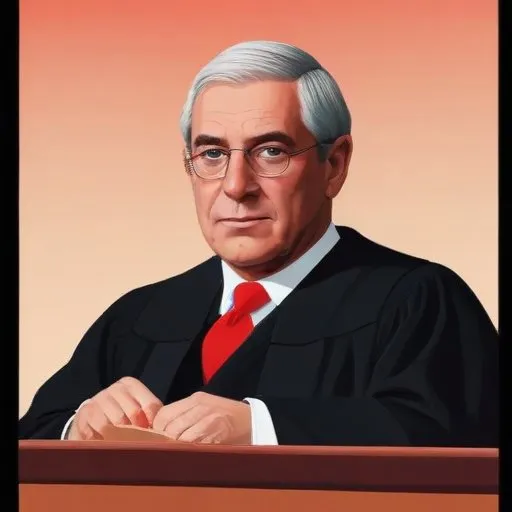
A 17th-century Chief Justice of Chester, he presided over the trial of the Seven Bishops, a landmark case that helped establish the supremacy of the common law. He's also known for his role in the Glorious Revolution.
James Whitelocke is renowned for his remarkable legal career, spanning over three decades, during which he contributed significantly to the English judiciary system. As a prominent figure in the House of Commons, he played a crucial role in shaping the country's legislative landscape between 1610 and 1622.
Whitelocke was born on November 28, 1570, as the younger of posthumous twin sons to Richard Whitelocke, a London merchant, and Joan Brockhurst, widow and daughter of John Colte of Little Munden, Hertfordshire. He received his education at Merchant Taylors School from 1575 and later at St. John's College, Oxford, where he was elected probationer in 1588.
Whitelocke's academic excellence earned him a fellowship at his college in November 1589. Under the guidance of esteemed tutors, including Rowland Searchfield and Alberico Gentile, he excelled in classics, logic, and civil law. He also studied Hebrew and other Semitic languages, showcasing his linguistic prowess.
In 1593, Whitelocke was admitted to the Middle Temple, where he was called to the bar in 1600. His professional trajectory saw him appointed as steward of the St. John's College estates in 1601, recorder of Woodstock in 1606, and steward of and counsel for Eton College in 1609.
In 1610, Whitelocke was elected as Member of Parliament for Woodstock, participating in debates on impositions and serving as the mouthpiece of the Commons on the presentation of the remonstrance against the royal inhibition.
Whitelocke formed lasting friendships with notable figures, including William Laud, Humphrey May, and Ralph Winwood, during his time at Oxford. He was also part of the circle of Sir Robert Bruce Cotton and a member of the Society of Antiquaries.
Whitelocke's contributions to the English judiciary system and his parliamentary involvement have left an indelible mark on the country's legal and political landscape. His commitment to upholding the rights of the subject and delimiting the royal prerogative continues to inspire generations of legal scholars and politicians.
James Whitelocke's remarkable legal career, parliamentary involvement, and personal relationships have cemented his position as one of the most distinguished figures in English history. His legacy continues to inspire and educate generations, serving as a testament to his enduring impact on the country's legal and political landscape.
Born in 1561
A 16th-17th century Renaissance figure who pioneered the scientific method and empiricism, and served as a prominent government official.
Born in 1787
The 14th Governor of Massachusetts, a Whig politician who served from 1834 to 1835 and later became a prominent lawyer, is most known for his brief but significant tenure in the state's highest office. He played a key role in shaping Massachusetts' early development and politics.
Born in 1552
A prominent figure in English law, he played a significant role in shaping the country's legal system and is remembered for his contributions to the development of common law.
