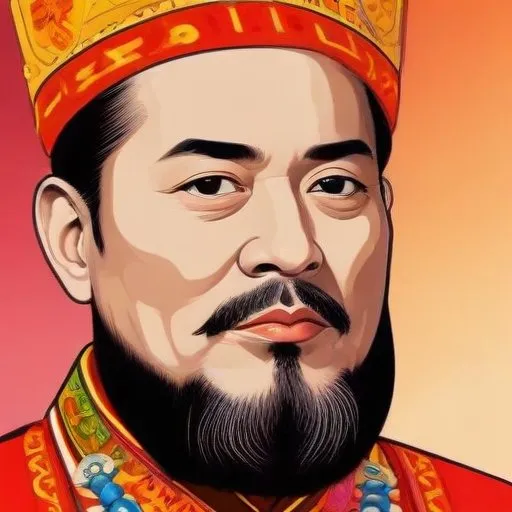
Jayaatu Khan Tugh Temr: The Cultural Patron and Poet Emperor of Yuan Dynasty China
A Nominal Khagan with a Lasting Legacy
Jayaatu Khan Tugh Temr, also known as the Emperor Wenzong of Yuan, is revered as the 12th Khagan of the Mongol Empire, despite only holding the title nominally due to the empire's division. This Chinese emperor's reign, though brief, was marked by a passion for cultural activities, poetry, and literature, earning him a distinct place in the annals of history.
Rise to Power and Abdication
Born on February 16, 1304, Tugh Temr was the second son of Khayishan Klg Khan (Emperor Wuzong) and a Tangut woman. Following his father's sudden death, his younger brother Ayurbarwada inherited the Yuan throne in 1311, leading to Tugh Temr's removal from the line of succession. However, with the help of his father's loyal partisans, he managed to restore the line of Khayishan to the throne. Tugh Temr's first reign lasted from October 16, 1328, to February 26, 1329, before he abdicated in favor of his brother Kusala, who then took the title of Emperor Mingzong.
Restoration and Reign
After Kusala's death, Tugh Temr reclaimed the throne on September 8, 1329, and ruled until his own demise on September 2, 1332. During his second reign, he sponsored numerous cultural activities, wrote poetry, and painted, showcasing his artistic side. Examples of his poetry and calligraphy have survived to this day, serving as a testament to his literary prowess.
Cultural Contributions
One of Tugh Temr's most significant contributions was the compilation of
The Imperial Dynasty's Grand Institutions, a comprehensive textual production that outlined the administrative practices and rules of the past, while looking forward to a fresh chapter in Yuan dynastic governance. This grand endeavor marked a new beginning for the Yuan dynasty, solidifying his legacy as a visionary leader.
Personal Milestones and Controversies
Tugh Temr's name, which means "Blessed/Lucky Khan," was a reflection of his fortunate circumstances. However, his reign was also marred by controversy, as he persecuted his eldest brother Kusala's family, an act he later expressed remorse for. Despite this, his cultural achievements and literary contributions have endured, casting a positive light on his tumultuous reign.
Legacy and Impact
As a cultural patron and poet emperor, Tugh Temr left an indelible mark on the Yuan dynasty and beyond. His passion for literature, art, and governance continues to inspire scholars and historians, cementing his place as one of the most fascinating figures in Chinese history.
- The Imperial Dynasty's Grand Institutions, a comprehensive textual production that outlined the administrative practices and rules of the past
- Poetry and calligraphy, showcasing his artistic side
- Sponsorship of cultural activities, promoting a cultural renaissance in the Yuan dynasty
Trivia and Fun Facts
* Tugh Temr's mother was a Tangut woman, highlighting the cultural exchange and diversity of the Yuan dynasty.
* His temple name, Emperor Wenzong, was a reflection of his cultural and literary achievements.
By exploring the life and reign of Jayaatu Khan Tugh Temr, we gain insight into the complexities of the Yuan dynasty and the enduring power of cultural patronage. Despite the controversies that marked his reign, Tugh Temr's contributions to literature, art, and governance have secured his place as a vital figure in Chinese history.
FAQ
Who was Jayaatu Khan Tugh Temür in Mongolian history?
Jayaatu Khan Tugh Temür was a Chinese emperor of the Yuan dynasty, which was the khanate established by Kublai Khan, a grandson of Genghis Khan. He ruled from 1307 to 1311 and was the ninth emperor of the Yuan dynasty.
What were Jayaatu Khan Tugh Temürs notable achievements?
During his reign, Jayaatu Khan Tugh Temür strengthened the Yuan dynastys economy, promoted Buddhism, and encouraged cultural exchange between China and Tibet. He also launched military campaigns against neighboring tribes and kingdoms.
What was Jayaatu Khan Tugh Temürs relationship with Tibetan Buddhism?
Jayaatu Khan Tugh Temür was a patron of Tibetan Buddhism and invited several prominent Buddhist masters to his court. He also supported the construction of Buddhist temples and monasteries throughout his empire.
How did Jayaatu Khan Tugh Temürs reign impact the Yuan dynasty?
Jayaatu Khan Tugh Temürs reign helped to stabilize the Yuan dynasty, which had faced internal strife and external threats. His economic and cultural reforms also contributed to the dynastys continued prosperity.
What is Jayaatu Khan Tugh Temürs legacy in Mongolian history?
Jayaatu Khan Tugh Temür is remembered as a wise and just ruler who promoted cultural exchange and religious tolerance. His legacy has endured in Mongolian history as a symbol of the Yuan dynastys cultural and economic achievements.