


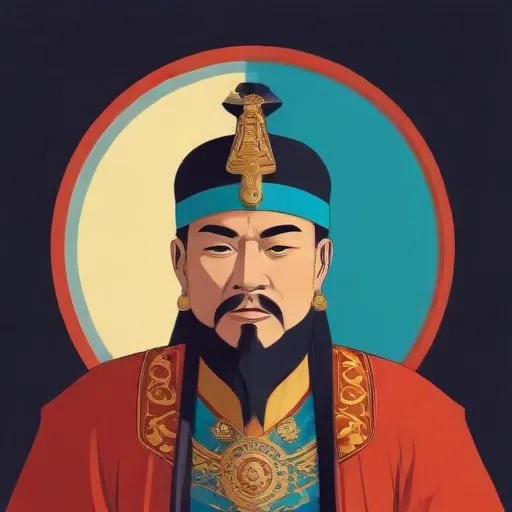
The last emperor of the Yuan dynasty in China, he's known for his attempts to restore the Mongol Empire to its former glory, but ultimately failed to prevent its decline.
Toghon Temr, also known as the Emperor Huizong of Yuan, was the last emperor of the Yuan dynasty and later the first emperor of the Northern Yuan dynasty. He is notable for being the last Khagan of the Mongol Empire, making him a significant figure in Chinese and Mongolian history.
Toghon Temr was born on May 25, 1320, to Kusala, also known as Khutughtu Khan or Emperor Mingzong, when he was in exile in Central Asia. His mother, Mailaiti, was a descendant of Arslan Khan, the chief of the Karluks. According to folklore, Toghon Temr's mother had an affair with the former Chinese Southern Song Emperor Gong of Song, Zhao Xian, who allegedly fathered him.
Toghon Temr's reign was marked by the decline of the Yuan dynasty, which was eventually overthrown by the Red Turban Rebellion. Despite this, he managed to maintain control of northern China and the Mongolian Plateau, establishing the Northern Yuan dynasty. He is also known for his patronage of Tibetan Buddhism, particularly the Karma Kagyu school, and was a student of the Karmapas.
Toghon Temr was a devout Buddhist and invited the Jonang savant Dlpopa Shrab Gyeltsen to teach him. Although Dlpopa Shrab Gyeltsen declined the invitation, Toghon Temr's interest in Tibetan Buddhism is a testament to his open-mindedness and willingness to learn.
Toghon Temr's legacy can be seen in the continued influence of Tibetan Buddhism in Mongolia and China. His patronage of the Karma Kagyu school has also contributed to the spread of Tibetan Buddhism throughout Asia.
Toghon Temr's reign marked the end of the Yuan dynasty and the beginning of the Northern Yuan dynasty. His legacy is complex, with both positive and negative connotations. While he is remembered for his cultural achievements, he is also associated with the decline of the Yuan dynasty.
Toghon Temr's life and reign serve as a fascinating glimpse into the complexities of Mongolian and Chinese history. His legacy continues to influence modern society, and his story remains a testament to the power of cultural exchange and patronage.
Born in 1186
The second Great Khan of the Mongol Empire, who expanded the empire's territories through military campaigns and established trade routes, is most known for his military conquests and administrative skills. He played a crucial role in shaping the Mongol Empire's governance and economy.
Born in 1206
The 3rd Great Khan of the Mongol Empire, who expanded the empire's territories through military campaigns and established trade routes, is most known for his conquests and administrative reforms.
Born in 1209
The Mongolian emperor who expanded the Mongol Empire, conquering vast territories and establishing a vast network of trade routes, while also promoting religious tolerance and meritocracy.
Born in 1215
Founded the Yuan dynasty in China, extending the Mongol Empire's reach and establishing trade routes, cultural exchange, and administrative systems that shaped the region's development.
Born in 1638
The first Qing dynasty emperor to rule from Beijing, he oversaw the transition from nomadic tribal leader to imperial ruler, establishing a strong foundation for the Qing dynasty.
Born in 1592
The second founder of the Qing dynasty, who unified various Mongol and Manchu tribes, and expanded the empire's borders through successful military campaigns. He is also known for creating a new administrative system and promoting Confucianism.
