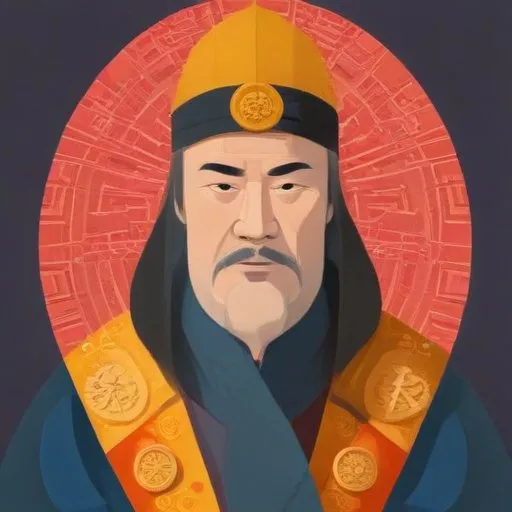
The Shunzhi Emperor: A Brief but Significant Reign
A New Era for the Qing Dynasty
The Shunzhi Emperor, also known by his temple name Emperor Shizu of Qing, was the second emperor of the Qing dynasty and the first to rule over China proper. He is known for being the youngest emperor to ascend to the throne, taking power at just five years old, and for laying the foundation for the Qing dynasty's rule over China.
Early Life and Ascension
Born Fulin on March 15, 1638, the Shunzhi Emperor was the son of
Hong Taiji, the founder of the Qing dynasty. Upon his father's death, a committee of Manchu princes chose the young Fulin as successor, citing his youth and inexperience as advantages in maintaining unity among the Manchu nobility. Two coregents, Dorgon and Jirgalang, were appointed to guide the young emperor until he came of age.
Reign and Achievements
The Shunzhi Emperor was enthroned as emperor of China in Beijing in November 1644. For the first seven years of his reign, real power lay in the hands of Dorgon, who led the Qing conquest of most of the territory of the fallen Ming dynasty. After Dorgon's death in 1650, the Shunzhi Emperor began to rule personally, attempting to reduce corruption and limit the influence of the Manchu nobility. He faced several challenges, including the resurgence of Ming loyalist resistance, but by 1661, his armies had defeated the last of the Qing's enemies.
Personal Life and Legacy
The Shunzhi Emperor's personal life is shrouded in mystery, with few documents surviving from his reign. However, it is known that he married two empresses, Xiaohuizhang and Xiaokangzhang, and had several sons and daughters. Tragically, he died of smallpox at the age of 22, succeeded by his third son, who would go on to become the Kangxi Emperor and reign for sixty years.
Impact on Modern Society
Despite his short reign, the Shunzhi Emperor played a significant role in establishing the Qing dynasty's rule over China. His efforts to reduce corruption and limit the influence of the Manchu nobility set a precedent for future emperors. Additionally, his military campaigns expanded the Qing empire, paving the way for future territorial gains.
Trivia and Fun Facts
- The Shunzhi Emperor was the youngest emperor to ascend to the throne in Chinese history.
- He was the first Qing emperor to rule over China proper.
- Despite his youth, the Shunzhi Emperor is remembered as a strong and capable leader.
Historical Context and Legacy
The Shunzhi Emperor's reign marked a significant turning point in Chinese history, as the Qing dynasty solidified its grip on power. Although his reign was short, he laid the groundwork for the Qing dynasty's rule over China, which would last for nearly three centuries.
FAQ
What were the major accomplishments of the Shunzhi Emperor?
The Shunzhi Emperors major accomplishments include stabilizing the Qing dynasty, defeating the Ming dynasty, and establishing a strong and centralized government in China.
How did the Shunzhi Emperor unify China?
The Shunzhi Emperor unified China by defeating the remaining Ming loyalists, incorporating Mongolia and Tibet into the Qing empire, and establishing a strong and centralized government.
What was the Shunzhi Emperors relationship like with his mother, Empress Dowager Xiaozhuang?
The Shunzhi Emperor had a close and influential relationship with his mother, Empress Dowager Xiaozhuang, who served as regent during his early reign and played a key role in his decision-making.
How did the Shunzhi Emperor reform the Qing government?
The Shunzhi Emperor reformed the Qing government by establishing a centralized bureaucracy, creating a system of provinces and governors, and implementing a system of examinations for government officials.
What is the Shunzhi Emperors legacy in Chinese history?
The Shunzhi Emperors legacy in Chinese history is that of a strong and effective leader who unified China, established a strong government, and paved the way for the Qing dynastys prosperity.