


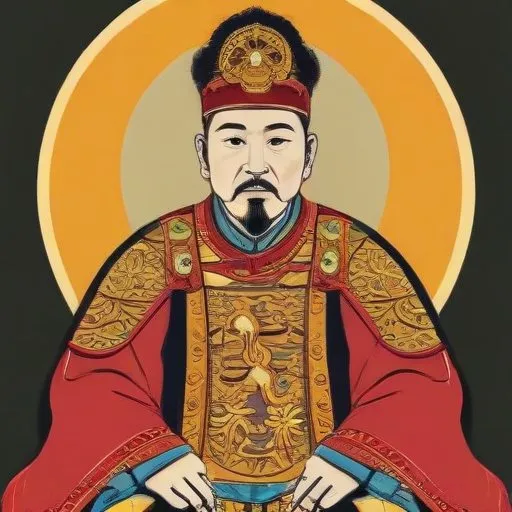
The fourth emperor of the Qing dynasty, who ruled China from 1722 to 1735, is known for his efficient administration, economic reforms, and military campaigns that expanded the empire's borders. He's also famous for his mysterious death, with rumors of assassination or poisoning.
The Yongzheng Emperor, also known as Emperor Shizong of Qing, is renowned for his remarkable reforms and military conquests that solidified the Qing dynasty's position in China. He is particularly celebrated for his tireless efforts to eradicate corruption, streamline the government, and expand the empire's borders.
Born on December 13, 1678, as Yinzhen, the Yongzheng Emperor was the fourth son of the Kangxi Emperor. His mother, Empress Xiaogongren, was originally a court attendant from the Manchu Uya clan. Raised by Noble Consort Tong until her passing when he was just 9 years old, Yinzhen received a rigorous education and was exposed to the outside world by his father.
The Yongzheng Emperor's reign was marked by a series of reforms aimed at creating a more effective government. He established the Grand Council, a powerful institution that would shape the future of the dynasty. Additionally, he:
The Yongzheng Emperor continued his father's efforts to expand the empire's borders. He:
The Yongzheng Emperor died on October 8, 1735, at the age of 56. He was succeeded by his fourth son, who would become the Qianlong Emperor. Despite his relatively short reign, the Yongzheng Emperor left a lasting impact on the Qing dynasty, establishing a period of peace and prosperity that would continue for generations.
The Yongzheng Emperor was known for his wisdom and insight. One of his most famous quotes is:
"A wise ruler must always be mindful of the people's needs and concerns."
The Yongzheng Emperor's reign marked a significant turning point in Qing dynasty history. His reforms and military campaigns set the stage for the dynasty's golden age, which would continue under the Qianlong Emperor. The Yongzheng Emperor's legacy serves as a testament to his visionary leadership and commitment to the welfare of his people.
The Yongzheng Emperor's remarkable achievements earned him numerous posthumous honors, including the temple name Emperor Shizong of Qing. His legacy continues to be celebrated in Chinese history, inspiring generations of leaders and scholars.
Did you know that the Yongzheng Emperor was:
These fascinating facts offer a glimpse into the life and times of this remarkable leader, highlighting his unique experiences and influences.
The Yongzheng Emperor's remarkable story serves as a testament to his unwavering dedication to the Qing dynasty and its people. His far-reaching reforms, military conquests, and commitment to good governance continue to inspire and educate generations of historians and scholars.
Born in 1711
Ruling China from 1735 to 1796, this emperor oversaw a golden age of prosperity, territorial expansion, and cultural achievements, leaving a lasting legacy in Chinese history.
Born in 1130
A leading figure in Confucianism, he synthesized Confucian classics into a coherent philosophical system, influencing East Asian thought for centuries. His teachings emphasized moral cultivation and self-reflection.
Born in 1893
Leader of the Chinese Communist Party who implemented radical social and economic reforms, including the Great Leap Forward and the Cultural Revolution, shaping modern China's politics and economy.
Born in 1887
Led the Nationalist Party in China, fighting against the Communist Party and later establishing the government of Taiwan. He's known for his role in shaping modern Chinese history.
Born in 1866
A Chinese revolutionary who led the overthrow of the Qing dynasty and founded the Republic of China, known for his role in shaping modern China's government and politics.
Born in 1904
A Chinese revolutionary and statesman who led the country's economic reforms, transforming it into a global superpower. He's credited with opening up China to the world and introducing capitalist principles.
