


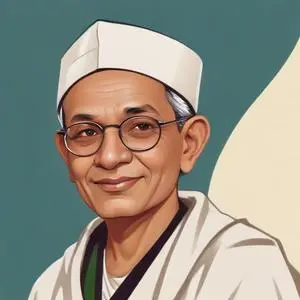
A key figure in India's freedom movement and a champion of social justice, known for leading mass movements against corruption and advocating for democratic reforms.
Jayaprakash Narayan, affectionately known as JP or Lok Nayak (People's Leader), was a prominent Indian independence activist, theorist, socialist, and political leader. He is revered for spearheading the mid-1970s opposition against Prime Minister Indira Gandhi, calling for her overthrow and advocating for a total revolution.
Born on October 11, 1902, in the village of Sitabdiara, Saran district, Bengal Presidency, British India (now Ballia district, Uttar Pradesh), Jayprakash Narayan Srivastava came from a Srivastava Kayastha family. His father, Harsu Dayal, was a junior official in the canal department of the state government, and his mother, Phul Rani Devi, was a homemaker.
At the tender age of nine, Narayan left his village to enroll in the seventh class of the collegiate school at Patna, marking his first break from village life. He stayed at Saraswati Bhawan, a student hostel where he interacted with older boys, including future leaders of Bihar, such as Krishna Singh and Anugrah Narayan Sinha.
In October 1918, Narayan married Prabhavati Devi, the elder daughter of Braj Kishore Prasad and an independence activist in her own right. After their wedding, Prabhavati joined Mahatma Gandhi's Sabarmati Ashram, where she became an inmate and an active participant in the freedom movement.
Narayan's involvement in the freedom movement began in the 1920s, when he joined the Indian National Congress and participated in the Salt March and the Quit India Movement. His association with Mahatma Gandhi and other prominent leaders of the time propelled him to the forefront of the independence movement.
In the 1950s and 1960s, Narayan became a prominent figure in Indian politics, advocating for social and economic reforms. He was a key proponent of the concept of "Total Revolution," which aimed to bring about a fundamental change in Indian society through a combination of political, social, and economic reforms.
In recognition of his contributions to the Indian freedom movement and his commitment to social service, Narayan was posthumously awarded the Bharat Ratna, India's highest civilian honor, in 1999. He had also received the Magsaysay Award for Public Service in 1965.
Jayaprakash Narayan's legacy extends beyond his contributions to the Indian freedom movement. He inspired a generation of Indians to work towards creating a more equitable and just society. His philosophy of "Total Revolution" continues to influence Indian politics and social movements to this day.
Narayan's commitment to social service and his unwavering dedication to the cause of freedom have made him an iconic figure in Indian history. His life and legacy serve as a testament to the power of courage, conviction, and perseverance in the face of adversity.
Born in 1869
Indian freedom fighter, activist, and philosopher who led India to independence from British rule through non-violent civil disobedience, inspiring civil rights movements worldwide.
Born in 1889
India's first Prime Minister, a key figure in the country's struggle for independence from British rule, and a champion of democracy and secularism. He played a crucial role in shaping modern India's government and economy.
Born in 1917
The first female Prime Minister of India, serving from 1966 to 1977 and again from 1980 until her assassination in 1984, known for her strong leadership and economic reforms.
Born in 1884
India's first president, a key figure in the country's struggle for independence, who played a crucial role in shaping the nation's early years. He's revered for his leadership and commitment to democracy.
Born in 1896
Fourth Prime Minister of India, known for his efforts to decentralize power and promote economic development, and for being the first Indian Prime Minister to resign from office.
Born in 1924
A renowned Indian poet and politician who served as the country's 10th Prime Minister, known for his efforts to strengthen India's economy and improve relations with neighboring countries.
Born in 1904
The second Prime Minister of India, leading the country through a tumultuous period, including a war with Pakistan, and known for his simplicity, honesty, and dedication to the nation. He is also credited with promoting the Green Revolution, which transformed India's agricultural sector.
Born in 1902
The 5th Prime Minister of India, a champion of rural development and social justice, who implemented land reforms and empowered farmers. He played a crucial role in shaping India's agricultural sector and economy.
