


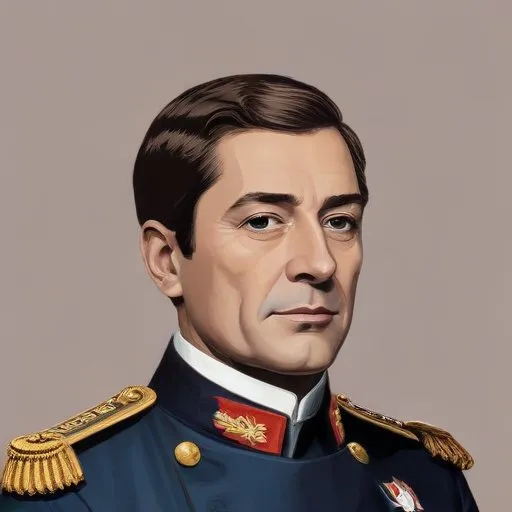
A French military leader who played a key role in the French Revolution and later became a prominent politician, serving as Minister of Foreign Affairs. He's most known for his military victories and reforms.
Known for his exceptional military prowess and strategic thinking, Marshal Jean-Baptiste Jourdan was a distinguished French military commander who played a pivotal role in the French Revolutionary Wars and the Napoleonic Wars. He is best remembered for leading the French to a decisive victory over the First Coalition at the Battle of Fleurus, a triumph that earned him the title of Marshal of the Empire by Emperor Napoleon I in 1804.
Born on April 29, 1762, in Limoges, France, Jourdan was the only surviving child of Roch Jourdan, a surgeon, and Jeanne Foreau-Franciquet. After his mother's death in childbirth, Jourdan was raised by his father and later by an uncle, the Abbé Laurent Jourdan, a parish priest who ran a boarding school in Beaurecueil, Provence. He received his basic education at the school and later worked as an apprentice clerk in Lyon before enlisting in the Royal Army at the age of 15.
Jourdan's military career spanned over four decades, during which he distinguished himself in numerous battles and campaigns. He fought in the French Revolutionary Wars, including the Battle of Fleurus, and later in the Napoleonic Wars, where he played a key role in several campaigns, including the Battle of Talavera and the Battle of Vitoria. His military acumen and leadership skills earned him the respect and admiration of his contemporaries, including Napoleon Bonaparte, who appointed him Marshal of the Empire in 1804.
Besides his military career, Jourdan was also an active politician. He served as a member of the Council of Five Hundred during the Directory phase of the French Revolution and later supported the Bourbon Restoration in 1815. He also played a significant role in the July Revolution of 1830, which led to the abdication of King Charles X and the ascension of King Louis Philippe. In his later years, Jourdan served as the governor of the Hôtel des Invalides, a prestigious military hospital in Paris.
Jourdan's legacy is a testament to his exceptional military leadership and strategic thinking. He is remembered as one of the most successful commanders of the French Revolutionary Army and played a crucial role in shaping the course of French history. His influence on modern warfare and military strategy is still studied by military historians and strategists around the world.
Jean-Baptiste Jourdan's life and legacy serve as a testament to his exceptional military leadership, strategic thinking, and dedication to his country. His impact on French history and modern warfare continues to inspire and educate people around the world.
Born in 1769
A French military leader who rose to prominence during the French Revolution and became Emperor of France, known for his military conquests and reorganization of Europe. He is also famous for his Napoleonic Code, which remains a foundation of modern law.
Born in 1753
A French general, mathematician, and politician who played a crucial role in the French Revolution and is considered the "Organizer of Victory" for his military strategies, and also made significant contributions to mathematics and engineering.
Born in 1755
A key figure in the French Revolution, leading the coup that overthrew Maximilien Robespierre and later serving as a key advisor to Napoleon Bonaparte. He played a crucial role in shaping French politics during a tumultuous period.
Born in 1767
Radical Jacobin leader during the French Revolution, known for his extreme views and role in the Reign of Terror.
Born in 1759
A leading figure of the French Revolution, instrumental in the overthrow of the monarchy and establishment of the First French Republic, known for his radical Jacobin ideology.
Born in 1758
Radical leader of the French Revolution, instrumental in the Reign of Terror, and advocate for the execution of King Louis XVI.
Born in 1759
A French lawyer and politician who served as Minister of Police under Napoleon, notorious for his ruthless suppression of dissent and creation of a vast network of spies and informants.
