


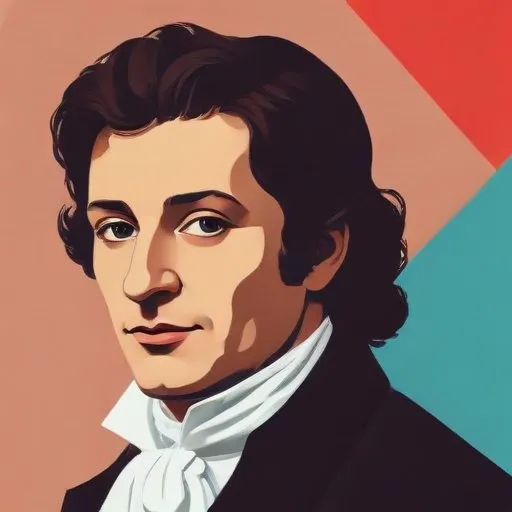
A French Baroque composer, he wrote sacred music and operas, and was a prominent figure in the development of the French opera.
Jean-Baptiste Morin, a renowned French composer, is celebrated for his distinctive fusion of French and Italian musical styles, which greatly influenced the development of the cantata genre. Born on February 2, 1677, Morin's innovative compositions earned him the esteemed position of Ordinaire de la Musique to Philippe, Duke of Orléans, and later, Maître de musique to Louise Adélaïde d'Orléans, daughter of the Duke, at the royal abbey of Chelles.
Morin's compositional output was marked by a series of notable works, including a set of cantatas published between 1706 and 1712. These cantatas, dedicated to his royal sponsor, showcased his ability to blend the sweetness of French melody with the variety and tempo of Italian accompaniments. The preface to the 1706 edition reveals Morin's deliberate effort to create a unique synthesis of styles, which would become a hallmark of his oeuvre.
Morin's compositional philosophy was guided by a desire to reconcile the contrasting styles of French and Italian music. He sought to create a distinctive sound that would appeal to the French court and its Italian influences. This eclecticism was reflective of the cultural exchange and artistic experimentation characteristic of the Baroque era.
Morin's life was marked by significant milestones, including his appointment as Maître de musique to Louise Adélaïde d'Orléans in 1719, a position he held until 1731. His affiliation with the royal abbey of Chelles, near Paris, afforded him the opportunity to compose music for a variety of ceremonies and occasions.
Morin's innovative approach to composition has had a lasting impact on the development of Western classical music. His fusion of French and Italian styles has influenced generations of composers, from Haydn to contemporary artists. As a pioneer of the cantata genre, Morin's contributions continue to shape the course of musical history.
Jean-Baptiste Morin's life and work are a testament to the cultural and artistic ferment of the Baroque era. His legacy is a reminder of the importance of innovation and experimentation in the pursuit of artistic excellence. As a composer, Morin embodied the spirit of his time, and his music continues to resonate with audiences today.
Morin passed away on April 27, 1745, leaving behind a rich body of work that has come to define the French Baroque style.
Born in 1564
Pioneering astronomer, physicist, and mathematician who played a major role in the Scientific Revolution, making key discoveries that challenged Aristotelian views and laid the foundation for modern science.
Born in 1571
A 17th-century trailblazer who discovered the three laws of planetary motion, revolutionizing our understanding of the solar system. He's also credited with being a pioneer in the field of astrology.
Born in 1546
A 16th-century astronomer who made precise measurements of the stars and planets, laying the foundation for modern astronomy. His data helped Kepler discover planetary orbits.
Born in 1473
A Renaissance-era mathematician and astronomer who proposed the heliocentric model, where the Sun is at the center of our solar system, revolutionizing our understanding of the universe.
Born in 1592
A 17th-century polymath who made significant contributions to the scientific revolution, merging ancient Greek philosophy with modern scientific methods, and providing a foundation for modern astronomy. He's also known for his work on the concept of the vacuum and the behavior of gases.
Born in 1596
Developed influential philosophical and mathematical concepts, including the famous phrase "I think, therefore I am," and laid the foundation for modern Western philosophy.
Born in 1623
A 17th-century genius who made major contributions to mathematics, physics, and philosophy, inventing the mechanical calculator and developing the theory of probability. His writings also explored the human condition and faith.
Born in 1629
A 17th-century polymath who made groundbreaking contributions to optics, probability theory, and astronomy, including the discovery of Saturn's rings and the largest moon, Titan.
