


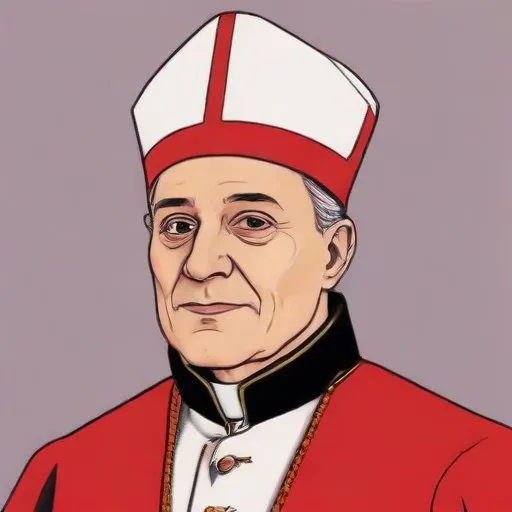
A powerful French cardinal who played a key role in shaping the Catholic Church during the 16th century, known for his diplomatic skills and patronage of the arts.
Jean, Cardinal of Lorraine, was a powerful French cardinal who held multiple bishoprics and archbishoprics, earning him the title of the richest prelate of his time. As a personal friend, companion, and advisor to King Francis I of France, Jean wielded significant influence in both the religious and royal circles of 16th-century France.
Born on April 9, 1498, in Bar-le-Duc, France, Jean was the sixth child of twelve to René II, Duke of Lorraine, and his wife Philippa of Guelders. His family was of noble descent, with his older brothers, Antoine and Claude, going on to become prominent dukes. Jean's younger brother, François, would later die in the Battle of Pavia in 1525.
In 1500, at the tender age of two, Jean succeeded Cardinal Raymond Peraudi as Coadjutor of his uncle Henri de Vaudemont-Lorraine, Bishop of Metz. This was a strategic move by his father, Duke René, to keep the bishopric of Metz within the family. Although Jean was too young to take on the role, his uncle continued to administer the diocese until his death in 1505.
When Jean turned twenty in 1518, he finally took on the responsibilities of the bishopric, receiving one-third of the episcopal revenues. The Cathedral Chapter, led by the Bishop of Toul, had managed the diocese in the interim.
Jean's influence and wealth continued to grow as he accumulated multiple bishoprics and archbishoprics. He held the titles of:
His extensive portfolio of bishoprics and archbishoprics earned him the title of the richest prelate of his time, as well as the most flagrant pluralist.
Jean's close relationship with King Francis I of France granted him significant influence in the royal court. He played a crucial role in shaping the king's policies and decisions, particularly in matters of religion.
As a cardinal, Jean's legacy extends beyond his own lifetime. He is remembered as a charismatic figure who navigated the complex web of religious and political alliances in 16th-century France.
In 1520, Jean's mother, Philippa of Guelders, retired to the Convent of S. Claire du Pont-à-Mousson, where she became a professed nun.
While little is known about Jean's personal life, his lavish lifestyle and extensive network of connections speak to his charisma and influence.
Jean, Cardinal of Lorraine, remains a fascinating figure in French history, a testament to the intricate dance of politics, power, and faith in the Renaissance era.
Born in 1550
Leader of the Catholic League during the French Wars of Religion, known for his role in the St. Bartholomew's Day massacre and attempts to overthrow the French monarchy.
Born in 1757
The last Bourbon king of France, ruling from 1824 to 1830, known for his ultra-royalist views and attempts to restore absolute monarchy, leading to the July Revolution.
Born in 1519
The Italian-French queen who married into the French monarchy and wielded significant power behind the scenes, known for her cunning politics and lavish court festivities. She sponsored the arts and architecture, leaving a lasting legacy on French culture.
Born in 1504
Leader of the Catholic Church during the Counter-Reformation, he excommunicated Queen Elizabeth I and played a key role in the Council of Trent.
Born in 1504
Leader of the Catholic Church during the Counter-Reformation, he excommunicated Queen Elizabeth I and played a key role in the Council of Trent.
Born in 1502
Introduced the Gregorian calendar, a solar-based calendar that's widely used today, reforming the Julian calendar's inaccuracies.
Born in 1542
The last Scottish monarch of the House of Stuart, she was a Catholic queen who faced Protestant rebellion and was eventually beheaded, sparking a centuries-long rivalry with England. She's known for her tumultuous reign and tragic fate.
