


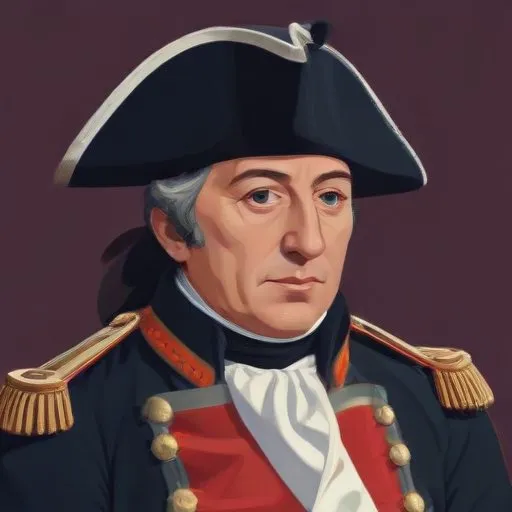
A French military leader who played a crucial role in the French Revolutionary Wars, particularly in the Battle of Hondschoote, which led to the capture of the Austrian Netherlands.
General Jean Nicolas Houchard, a French military leader, is often overlooked in the annals of history, yet his bravery and patriotism played a significant role in shaping the French Revolution and the French Revolutionary Wars. Born on January 24, 1739, in Forbach, Lorraine, Houchard's military career spanned over three decades, leaving an indelible mark on the landscape of French history.
Houchard began his military career at the tender age of sixteen, enlisting in the Régiment de Royal-Allemand cavalerie. His early years were marked by bravery and distinction, earning him a promotion to captain in the Bourbon-Dragons regiment in Corsica. It was during this time that he participated in the Battle of Ponte Novu, where he received a deep sabre cut across his cheek and a gunshot wound to his mouth, leaving him disfigured.
Houchard's unwavering support for the French Revolution earned him the respect and admiration of his contemporaries. In 1792, he became colonel of a regiment of Chasseurs-cheval in the army of General Custine. Following Custine's execution, Houchard replaced him as Commander-in-Chief of the Army of the North in August 1793.
The Battle of Hondschoote, fought on September 6-8, 1793, marked a significant turning point in Houchard's career. Although he failed to exert control over the entire army, his leadership and bravery in the face of adversity earned him recognition. However, his inability to organize an effective pursuit after the battle led to criticism and eventually, his downfall.
Houchard's detractors criticized him for his lack of strategic vision and inability to adapt to changing circumstances on the battlefield. Despite his bravery and patriotism, he was eventually denounced as incapable and removed from command.
General Jean Nicolas Houchard's legacy was all but forgotten in the aftermath of the French Revolution. His bravery and sacrifices were overshadowed by the rise of more prominent leaders, such as Napoleon Bonaparte. Yet, his contributions to the French Revolution and the French Revolutionary Wars remain an integral part of France's rich history.
In a letter to a colleague, Houchard once wrote, "Is there any more cruel position than this?" - a poignant reflection of his doubts and fears regarding his role as Commander-in-Chief.
Houchard's story serves as a poignant reminder of the tumultuous nature of the French Revolution. His bravery, patriotism, and ultimate downfall are a testament to the complexities of war and the human experience. As we reflect on his legacy, we are reminded of the sacrifices made by countless individuals who fought for freedom, equality, and liberty during this pivotal period in history.
Born in 1753
A French general, mathematician, and politician who played a crucial role in the French Revolution and is considered the "Organizer of Victory" for his military strategies, and also made significant contributions to mathematics and engineering.
Born in 1755
A key figure in the French Revolution, leading the coup that overthrew Maximilien Robespierre and later serving as a key advisor to Napoleon Bonaparte. He played a crucial role in shaping French politics during a tumultuous period.
Born in 1767
Radical Jacobin leader during the French Revolution, known for his extreme views and role in the Reign of Terror.
Born in 1758
Radical leader of the French Revolution, instrumental in the Reign of Terror, and advocate for the execution of King Louis XVI.
Born in 1759
A leading figure of the French Revolution, instrumental in the overthrow of the monarchy and establishment of the First French Republic, known for his radical Jacobin ideology.
Born in 1760
French journalist and politician who sparked the French Revolution with his impassioned speeches and writings, advocating for democracy and social reform.
Born in 1743
A radical Jacobin leader who advocated for the execution of King Louis XVI and was a key figure in the Reign of Terror during the French Revolution, known for his extreme views and assassination in his bathtub.
