


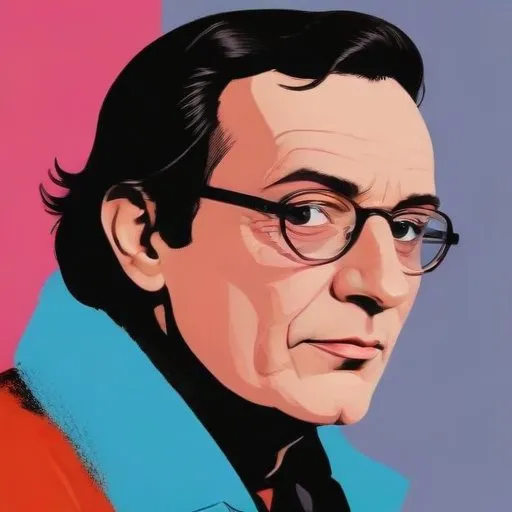
French writer and literary critic known for his innovative and influential work on literary theory, particularly in the fields of structuralism and post-structuralism.
Jean-Pierre Richard, a renowned French writer and literary critic, is celebrated for his profound exploration of the intricate relationship between an author's life and their written works. Through his extensive research and critique, Richard has shed light on the intimate experiences that shape the literary creations of prominent writers, leaving an indelible mark on the world of literary criticism.
Born on July 15, 1922, Richard embarked on his academic journey at the prestigious École Normale Supérieure in 1941. He successfully passed the agrégation in literature in 1945 and later obtained his doctoral degree, doctorat ès lettres, in 1962 from the University of Paris.
Richard's literary career spans over four decades, with his first book, Littérature et Sensation, published in 1954. This seminal work catapulted him into the spotlight, earning him critical acclaim for his innovative approach to literary analysis. The book delved into the works of notable writers such as Stendhal, Flaubert, Fromentin, and the Goncourt brothers, examining the correlation between their writings and their sensory experiences of the world.
In 1962, Richard published Univers Imaginaire de Mallarmé, a groundbreaking study that remains one of the most significant analyses of the poet's work to this day. This masterpiece cemented Richard's position as a leading literary critic, further solidifying his reputation in the academic community.
Richard's intellectual pursuits were greatly influenced by his collaborations with esteemed scholars, including Georges Poulet, with whom he was often associated with the Geneva School. This intellectual circle, comprising luminaries such as Albert Béguin, Jean Starobinski, and Jean Rousset, played a pivotal role in shaping Richard's critical approach.
Richard's literary oeuvre encompasses a range of works, including:
Jean-Pierre Richard's remarkable career has left an indelible mark on the realm of literary criticism. His innovative approach has inspired generations of scholars, solidifying his position as a pioneering figure in the field. Through his tireless pursuit of knowledge and his dedication to uncovering the intricacies of literary creation, Richard has crafted a lasting legacy that continues to captivate and inspire scholars and readers alike.
Born in 1924
A French journalist and author who wrote novels that often explored the intersection of mythology and reality, and is best known for his reimagining of the Pied Piper legend in "The Ogre".
95 Years Old
A French sociologist, anthropologist, and philosopher who developed the concept of "cultural capital" and critiqued social inequality, highlighting how power and privilege are maintained through cultural and symbolic means.
Born in 1915
A French philosopher, theorist, and critic who challenged traditional notions of culture, literature, and identity through his influential writings on semiotics, mythology, and structuralism. He's most known for his critical theories on modern society and culture.
96 Years Old
A French sociologist and philosopher who developed theories on consumerism, hyperreality, and the simulation of reality, arguing that our postmodern world is more concerned with images and appearances than reality itself.
99 Years Old
A French historian and philosopher who critiqued power structures and social norms, arguing that knowledge and truth are shaped by those in power. He's known for his concepts of power, discipline, and surveillance.
Born in 1905
Existentialist philosopher and playwright who argued that humans have complete freedom to choose their actions and create their own meaning in life, influencing modern thought on morality and individual responsibility.
Born in 1908
A pioneering feminist philosopher who wrote extensively on ethics, politics, and gender, famously arguing that "one is not born, but rather becomes, a woman."
Born in 1913
A French novelist, philosopher, and journalist who wrote influential works like "The Stranger" and "The Plague", exploring absurdism and the human condition.
