


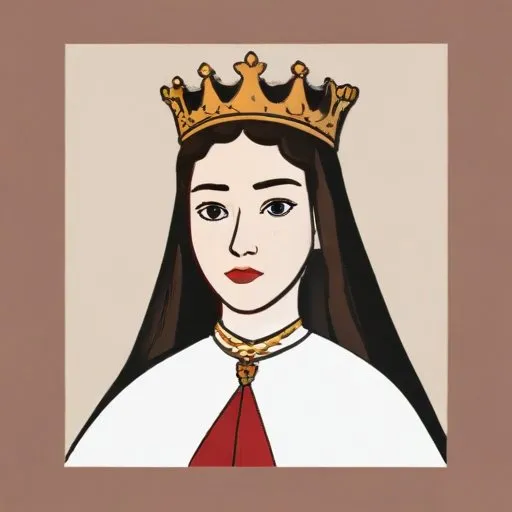
The Queen of Navarre was a powerful leader who ruled with a strong sense of justice and promoted the Protestant Reformation in France, playing a key role in the country's religious wars. She was a patron of the arts and a strong advocate for women's rights.
Jeanne d'Albret, also known as Jeanne III, was the Queen of Navarre from 1555 to 1572 and a key figure in the French Wars of Religion. She was the acknowledged spiritual and political leader of the French Huguenot movement, and her legacy continues to inspire and influence people to this day.
Jeanne was born on 16 November 1528, in the royal palace of Saint-Germain-en-Laye, France, to Henry II, King of Navarre, and his wife Marguerite of Angoulme. In 1541, she married William, Duke of Jülich-Cleves-Berg, but the marriage was annulled in 1545.
In 1548, Jeanne married Antoine de Bourbon, Duke of Vendôme, and they had two surviving children, Henry and Catherine. When her father died in 1555, Jeanne and Antoine ascended the Navarrese throne, reigning as joint rulers until Antoine's death from battle wounds in 1562.
After her public conversion to Calvinism in 1560, Jeanne joined the Huguenot side and became the acknowledged leader of the movement. During the first and second war, she remained relatively neutral, but in the third war, she fled to La Rochelle, becoming the de facto leader of the Huguenot-controlled city.
Jeanne negotiated a peace treaty with the French queen mother Catherine de Medici and arranged the marriage of her son, Henry, to Catherine's daughter Marguerite. She died suddenly in Paris in 1572, and her son succeeded her as Henry III and later became the first Bourbon king of France as Henry IV.
Jeanne's legacy extends beyond her role as Queen of Navarre. She was the last active ruler of Navarre, and her son inherited her kingdom. However, as he was constantly leading the Huguenot forces, he entrusted the government of Bearn to his sister, Catherine, who held the regency for more than two decades. In 1620, Jeanne's grandson Louis XIII annexed Navarre to the French crown.
Although there are no recorded quotes directly attributed to Jeanne d'Albret, her actions and legacy speak volumes about her dedication to her faith and her people.
Jeanne's leadership of the Huguenot movement and her role in the French Wars of Religion continue to inspire people today. Her legacy serves as a reminder of the importance of standing up for one's beliefs and fighting for what is right, even in the face of adversity.
Born in 1519
King of France from 1547 to 1559, known for his cultural and artistic patronage, and his role in the Italian Wars.
Born in 1553
The Queen of France who brokered peace between Catholics and Protestants through her marriage, but her lavish lifestyle and scandals sparked the St. Bartholomew's Day massacre.
Born in 1542
The last Scottish monarch of the House of Stuart, she was a Catholic queen who faced Protestant rebellion and was eventually beheaded, sparking a centuries-long rivalry with England. She's known for her tumultuous reign and tragic fate.
Born in 1519
A 16th-century French theologian and scholar who played a key role in shaping Protestantism, particularly Calvinism, through his writings and teachings. He's also known for his Greek New Testament translation.
