


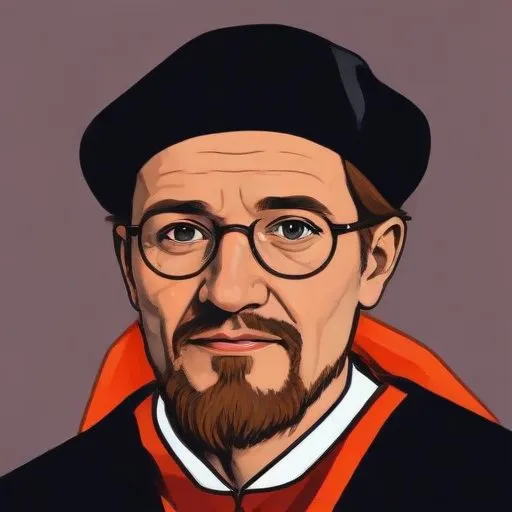
A 16th-century German scholar and translator who produced influential Latin translations of ancient Greek texts, making classical knowledge accessible to a broader audience.
Joachim Camerarius, the Elder, was a towering figure of the German Renaissance, renowned for his exceptional classical scholarship, mastery of Greek and Latin, and profound understanding of the ancient world. His critical acumen and vast knowledge earned him a reputation as one of the foremost scholars of his time, leaving an indelible mark on the world of classical studies.
Born on April 12, 1500, in Bamberg, Prince-Bishopric of Bamberg, Camerarius came from a family of scholars and civil servants. His family name was Liebhard, but he adopted the surname Camerarius, derived from the office of chamberlain (Kammermeister) held by his ancestors.
Camerarius pursued his academic interests in Leipzig, Erfurt, and Wittenberg, where he befriended the illustrious Philipp Melanchthon. This friendship would prove instrumental in shaping his future as a scholar and reformer.
In 1530, Camerarius was appointed as deputy for Nuremberg to the Diet of Augsburg, where he collaborated with Melanchthon in drafting the Augsburg Confession, a pivotal document in the Lutheran Reformation. This experience demonstrated his ability to navigate the complexities of politics and theology, earning him recognition as a scholar-statesman.
Subsequently, he was commissioned by Duke Ulrich of Württemberg to reorganize the University of Tübingen in 1535 and later, in 1541, he performed a similar service at Leipzig, where he spent the majority of his life.
Camerarius was a prolific translator, rendering into Latin the works of prominent Greek authors such as Herodotus, Demosthenes, Xenophon, Homer, Theocritus, Sophocles, Lucian, Theodoretus, and Nicephorus. His translations not only preserved ancient knowledge but also made it accessible to a broader audience, contributing to the Renaissance humanist movement.
Camerarius's contributions to classical scholarship, his involvement in the Reformation movement, and his role as a statesman left an enduring impact on the intellectual and religious landscape of his time. He died on April 17, 1574, leaving behind a legacy that continues to inspire scholars and intellectuals to this day.
Camerarius was the father of Joachim Camerarius the Younger, a prominent physician, and the grandfather of Ludwig Camerarius, a leading figure in the Thirty Years' War. His family played a significant role in shaping European history, with many members contributing to the fields of medicine, politics, and scholarship.
Through his works and achievements, Joachim Camerarius the Elder remains an exemplar of Renaissance humanism, demonstrating that rigorous scholarship, linguistic mastery, and cultural curiosity can lead to a profound understanding of the ancient world and its relevance to modern society.
Born in 1497
A 16th-century Renaissance scholar who made significant contributions to the development of the Protestant Reformation and education, known for his theological writings and astronomical observations.
Born in 1483
A German monk and priest who sparked the Protestant Reformation, challenging Catholic Church authority and shaping Western Christianity. He's famous for nailing 95 theses to a church door, sparking a religious revolution.
Born in 1485
A key figure in the Protestant Reformation, he played a crucial role in shaping Lutheran theology and was a close advisor to Martin Luther. He's also known for his work in establishing the Lutheran Church in Denmark and Norway.
Born in 1493
A 16th-century Lutheran reformer and theologian who played a key role in shaping the Protestant Reformation, particularly in Germany. He's known for his translations of Luther's works and his own theological writings.
Born in 1498
A 16th-century theologian who sparked controversy by anonymously publishing a preface to Copernicus' De revolutionibus orbium coelestium, which led to a misunderstanding of the astronomer's heliocentric model. They also contributed to the development of Lutheran theology.
