


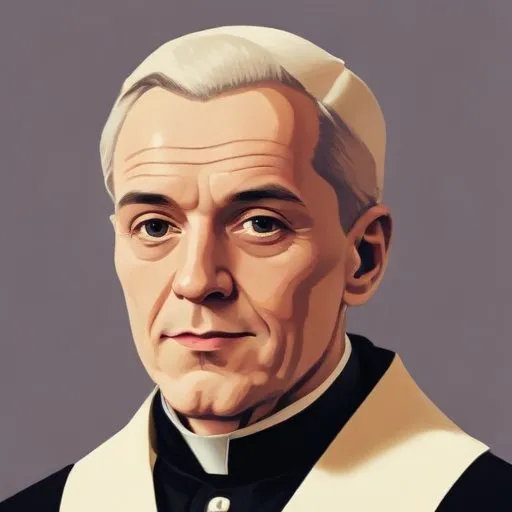
A key figure in the Protestant Reformation, he played a crucial role in shaping Lutheran theology and was a close advisor to Martin Luther. He's also known for his work in establishing the Lutheran Church in Denmark and Norway.
Johannes Bugenhagen was a German theologian and Lutheran priest who introduced the Protestant Reformation in the Duchy of Pomerania and Denmark in the 16th century. He is best known for organizing Lutheran churches in Northern Germany and Scandinavia, earning him the title "Second Apostle of the North."
Born on June 24, 1485, in Wollin, Duchy of Pomerania (now Wolin, Poland), Bugenhagen was one of three children of local councilor Gerhard Bugenhagen. He studied artes at the University of Greifswald from 1502 to 1504 and later became the rector of the local school in Treptow an der Rega (now Trzebiatow, Poland) in 1504.
In 1509, Bugenhagen was ordained as a priest at St. Mary's Church in Treptow, despite not having studied theology. He served as a vicar at the Kanonikerkolleg of that church and later became a Biblical lecturer at Belbuck Abbey in 1517. It was during this time that he encountered the theology of Martin Luther, which initially didn't resonate with him. However, after further study, Bugenhagen became a supporter of the Reformation and moved to Wittenberg in 1521.
In Wittenberg, Bugenhagen was elected parish pastor on October 25, 1523, making him Martin Luther's pastor and confessor. He played a crucial role in translating the Holy Bible from Greek and Hebrew into German, working closely with Luther and other reformers. Bugenhagen's involvement in the Reformation earned him the nickname "Doctor Pomeranus" from Luther himself.
Bugenhagen's significant contribution to the Reformation was the organization of Lutheran churches in Northern Germany and Scandinavia. He worked tirelessly to establish a Lutheran church order, visiting various regions to promote the Reformation and provide guidance to local churches. His efforts earned him recognition as the "Second Apostle of the North."
Bugenhagen's contributions to the Reformation are still commemorated in the Lutheran Church–Missouri Synod, which celebrates him as a pastor on April 20. His legacy extends beyond the Lutheran Church, with his work having a lasting impact on the Protestant Reformation as a whole.
Bugenhagen's life and work coincided with a tumultuous period in European history, marked by the Protestant Reformation and the ensuing theological debates. His involvement in the Reformation and his efforts to organize Lutheran churches left a lasting legacy, shaping the course of Protestantism in Northern Europe.
Bugenhagen's story serves as a testament to the power of faith and conviction, inspiring generations of theologians, pastors, and scholars. As the "Second Apostle of the North," Johannes Bugenhagen remains an important figure in the history of the Protestant Reformation.
Born in 1483
A German monk and priest who sparked the Protestant Reformation, challenging Catholic Church authority and shaping Western Christianity. He's famous for nailing 95 theses to a church door, sparking a religious revolution.
Born in 1497
A 16th-century Renaissance scholar who made significant contributions to the development of the Protestant Reformation and education, known for his theological writings and astronomical observations.
Born in 1499
A prominent figure in the Protestant Reformation, this theologian played a key role in shaping Lutheran theology and was a close associate of Martin Luther. He's also known for his biblical commentaries and liturgical reforms.
Born in 1493
A 16th-century Lutheran reformer and theologian who played a key role in shaping the Protestant Reformation, particularly in Germany. He's known for his translations of Luther's works and his own theological writings.
Born in 1498
A 16th-century theologian who sparked controversy by anonymously publishing a preface to Copernicus' De revolutionibus orbium coelestium, which led to a misunderstanding of the astronomer's heliocentric model. They also contributed to the development of Lutheran theology.
