


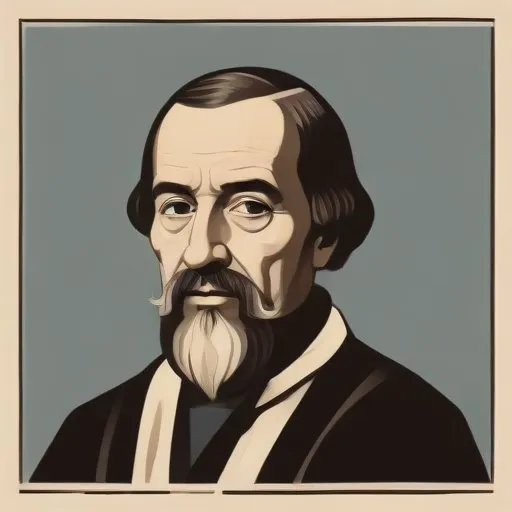
A prominent figure in the Protestant Reformation, this theologian played a key role in shaping Lutheran theology and was a close associate of Martin Luther. He's also known for his biblical commentaries and liturgical reforms.
Johannes Brenz is renowned for his pivotal role in the Protestant Reformation, particularly in the Duchy of Württemberg, where he championed the cause of evangelical liberty and administered the Lord's Supper in both kinds. As a prominent Lutheran theologian, Brenz's contributions to the Reformation movement had a profound impact on the development of Christianity in Germany.
Born on June 24, 1499, in the Imperial City of Weil der Stadt, Brenz received his education at the University of Heidelberg. He became magister and regent of the Realistenbursa in 1518, where he delivered philological and philosophical lectures. His lectures on the Gospel of Matthew, however, were prohibited due to his popularity and novel exegesis, which had already won him over to the side of Martin Luther.
In 1522, Brenz was threatened with a trial for heresy, but he escaped through a call to the pastorate of Schwäbisch Hall. It was here that he found a strong ally in Johann Isenmann, who became pastor of the parish church at Hall. Together, they discarded the Feast of Corpus Christi and transformed the monastery of the Discalced Friars into a school.
During the German Peasants' War, Brenz condemned the abuse of evangelical liberty by the peasants, pleading for mercy to the conquered and warning the magistracy of their duties. At Christmas, he administered the Lord's Supper in both kinds, and by Easter of the following year, he had framed the first regulations for the church and school.
Brenz prepared two catechisms for the young in 1528, characterized by simplicity, warmth, and a childlike spirit. His most notable work, however, was the Syngramma Suevicum, published on October 21, 1525, which attacked Johannes Oecolampadius and expounded on the creative power of Christ's word.
Johannes Brenz's efforts as a Protestant Reformer not only shaped the course of Christianity in Germany but also had a lasting impact on the development of Lutheran theology. His commitment to evangelical liberty, education, and social reform continues to inspire generations of theologians and reformers.
Through his tireless efforts, Johannes Brenz left an indelible mark on the Protestant Reformation, paving the way for future generations of reformers and theologians.
Born in 1483
A German monk and priest who sparked the Protestant Reformation, challenging Catholic Church authority and shaping Western Christianity. He's famous for nailing 95 theses to a church door, sparking a religious revolution.
Born in 1497
A 16th-century Renaissance scholar who made significant contributions to the development of the Protestant Reformation and education, known for his theological writings and astronomical observations.
Born in 1509
A French pastor and theologian who played a key role in the Protestant Reformation, shaping Christian theology and influencing Western civilization. He's famous for his teachings on predestination and his role in establishing Calvinism.
Born in 1484
Leader of the Swiss Reformation, advocating for church reform and inspiring other Protestant movements.
Born in 1498
A 16th-century theologian who sparked controversy by anonymously publishing a preface to Copernicus' De revolutionibus orbium coelestium, which led to a misunderstanding of the astronomer's heliocentric model. They also contributed to the development of Lutheran theology.
Born in 1520
A 16th-century Croatian theologian and reformer who played a key role in shaping the Lutheran Reformation, particularly through his writings on the nature of sin and justification. He's also known for his critical approach to biblical interpretation.
