


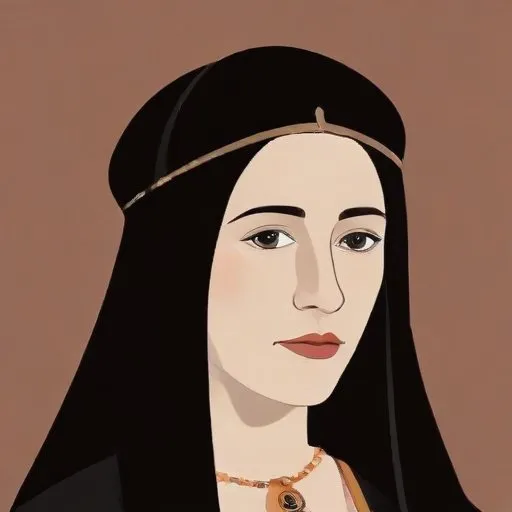
The queen who ruled Naples from 1516 to 1518, known for her brief but tumultuous reign marked by power struggles and conspiracies.
Joanna of Aragon, Queen of Naples, is remembered for her unwavering determination and astute leadership as the second wife of King Ferdinand I of Naples. As the regent General Lieutenant of Naples, she played a crucial role in shaping the fate of the kingdom, making her one of the most influential women in 15th-century Italy.
Joanna was born on June 16, 1455, in Barcelona, Spain, as the second child of King John II of Aragon and his second wife, Juana Enríquez de Córdoba. As the youngest legitimate child of the king, Joanna's early life was marked by the intrigue and politics of the royal court.
In 1476, King Ferdinand I of Naples, an illegitimate son of Joanna's uncle Alfonso V of Aragon, asked for her hand in marriage. The union was a strategic move to strengthen ties between the two kingdoms, and John II accepted the proposal. The wedding contract was signed in Navarre on September 14, 1476, and ratified on November 25. As part of the agreement, John II provided a dowry of 100,000 gold florins, while Ferdinand gifted Joanna numerous duchies and cities, including Sorrento, Theano, and Sulmona, as well as an annual allowance of over 20,000 ducats.
Joanna arrived in Naples on September 1, 1477, and the formal wedding ceremony took place on September 14, officiated by Rodrigo Borgia, the future Pope Alexander VI. Over the years, Joanna gave birth to two children, both of whom would play significant roles in the kingdom's future.
Joanna demonstrated a keen sense of politics and governance, often taking matters into her own hands. In 1485, she embarked on a journey through Italy, aiming to ensure loyalty to her husband and quash rebellions instigated by Baron Antonello Sanseverino and supported by Pope Innocent VIII and Cardinal Giulio della Rovere. After the conspiracy was suppressed, Joanna continued to assert her influence, visiting monasteries in Abruzzo with her daughter Joanna.
Following Ferdinand I's death on January 25, 1494, Joanna was thrust into the role of Queen Dowager. Her husband's son, Alfonso II, abdicated and fled, leaving Joanna to serve as regent until the formal succession of Alfonso's son, Ferdinand II, on February 22, 1495.
Joanna of Aragon's remarkable life and reign left an indelible mark on Naples and the Aragonese dynasty. Her perseverance, strategic thinking, and leadership set her apart as one of the most prominent female figures of the 15th century. Although her life was marked by turmoil and intrigue, Joanna's unwavering dedication to her kingdom and her people remains an enduring testament to her strength and character.
Born in 1350
King of Aragon from 1387 to 1396, known for his tumultuous reign marked by conflicts with the nobility and the papacy. He was also a patron of the arts and literature.
Born in 1380
Unified the Crown of Aragon, ruling over a vast territory in eastern Spain, and sponsored the voyages of Christopher Columbus, leading to the discovery of the New World.
Born in 1451
Unified the Spanish kingdoms, sponsored Christopher Columbus's voyage to the Americas, and established the Spanish Inquisition.
Born in 1423
King of Naples who ruled from 1458 to 1494, known for his military campaigns and cultural achievements, including patronizing artists and writers.
Born in 1448
King of Naples from 1494 to 1495, known for his brief but tumultuous reign marked by wars and power struggles.
Born in 1403
King of France from 1422 to 1461, he played a crucial role in ending the Hundred Years' War by expelling the English from French territory. He also established a strong centralized government.
Born in 1785
The last king of the French monarchy before the French Revolution, known for his tragic and mysterious life, including his imprisonment and disputed death.
