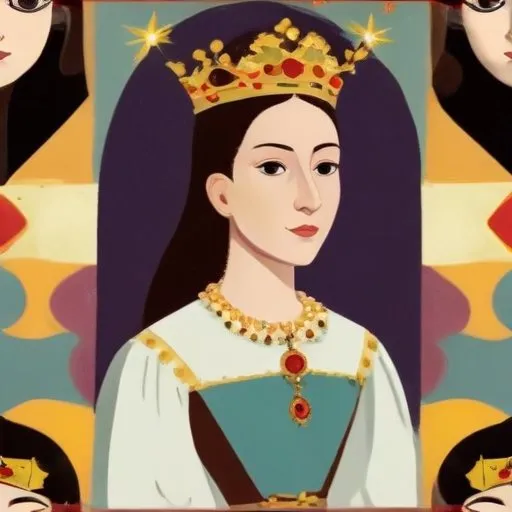
Joan of Valois, Queen of Navarre: A Trailblazer in Medieval Politics
A Brief Introduction
Joan of Valois, Queen of Navarre, was a 14th-century monarch who left an indelible mark on the history of Navarre. Born in 1343, she was the daughter of
John II of France, also known as John the Good, and
Bonne of Luxembourg. Her marriage to
Charles II of Navarre, also known as Charles the Bad, catapulted her to the throne of Navarre, where she ruled as regent during her husband's absence.
A Life of Politics and Intrigue
Joan's life was marked by a series of strategic alliances and diplomatic maneuvers. Initially betrothed to John of Brabant, son of John III, Duke of Brabant, the marriage was eventually annulled, and Joan was married to Charles II of Navarre in 1352. This union was significant, as it formed an alliance between the French monarchy and the Kingdom of Navarre.
Rise to Power
In 1360, at the age of 17, Joan joined her husband in Pamplona, the capital of Navarre. Her marriage, initially distant, eventually blossomed, and Charles II developed confidence in Joan's abilities. In 1369, he appointed her regent of Navarre, entrusting her with the governance of the kingdom during his absence. Joan rose to the challenge, ruling successfully until her husband's return in 1372.
Personal Life and Legacy
Joan and Charles had seven children, including
Charles III of Navarre, who would eventually succeed his father as king. Her daughters, Marie, Bonne, and Joanna, would go on to form important alliances through marriage, strengthening the ties between Navarre and other European monarchies.
Death and Burial
Joan died in 1373, at the age of 30, in Évreux. She was buried in the Royal Abbey of Saint Denis, a testament to her status as a member of the French royal family.
Impact on Navarre and Beyond
Joan's legacy extends beyond the boundaries of Navarre. Her successful governance of the kingdom during her husband's absence demonstrates her capabilities as a leader and a politician. Her strategic alliances through marriage solidified the position of Navarre in European politics, paving the way for future generations of monarchs.
Lessons from the Past
Joan's life serves as a reminder of the importance of strong leadership, diplomatic acumen, and strategic alliances. Her story is a testament to the power of women in medieval politics, offering valuable insights for modern leaders and policymakers.
- Married Charles II of Navarre in 1352
- Ruled as regent of Navarre from 1369 to 1372
- Had seven children, including Charles III of Navarre
- Died in 1373 at the age of 30
- Buried in the Royal Abbey of Saint Denis
Joan of Valois, Queen of Navarre, may have lived in the 14th century, but her legacy continues to inspire and educate us today. Her story is a powerful reminder of the impact one person can have on the course of history.
FAQ
Who was Joan of Valois, Queen of Navarre?
Joan of Valois, Queen of Navarre was a queen consort of Navarre from 1389 to 1413, married to Charles III of Navarre. She was a member of the French royal house of Valois and played a significant role in the politics of Navarre.
What were Joan of Valois, Queen of Navarres main responsibilities?
As queen consort, Joan of Valois, Queen of Navarres main responsibilities included supporting her husband, Charles III, in governing Navarre, as well as overseeing the royal household and its finances.
How did Joan of Valois, Queen of Navarre influence Navarrese politics?
Joan of Valois, Queen of Navarre exerted significant influence over Navarrese politics, using her connections to the French royal court to secure advantageous alliances and trade agreements for her husbands kingdom.
What was Joan of Valois, Queen of Navarres relationship with her husband?
Joan of Valois, Queen of Navarres marriage to Charles III of Navarre was a happy and supportive one, with the couple working together to strengthen Navarres position in Europe.
What is Joan of Valois, Queen of Navarres legacy?
Joan of Valois, Queen of Navarres legacy is one of effective governance and diplomatic skill, as she successfully navigated the complex world of medieval politics to secure advantages for her husbands kingdom.