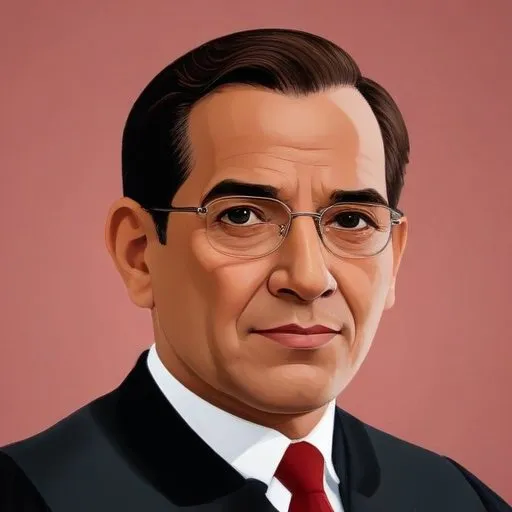
Joaquín Balaguer: The Enigmatic Leader of the Dominican Republic
A Legacy of Power and Controversy
Joaquín Balaguer, a Dominican politician, scholar, writer, and lawyer, is known for serving three non-consecutive terms as President of the Dominican Republic from 1960 to 1962, 1966 to 1978, and 1986 to 1996. His complex and often contradictory legacy is marked by a mix of liberalization and state terrorism, earning him the reputation as a caudillo, a strongman ruler.
Early Life and Introduction to Politics
Balaguer was born on September 1, 1906, in Navarrete, Santiago Province, in the northwestern corner of the Dominican Republic. His father, Joaquín Jesús Balaguer Lespier, was a Spaniard of Catalan and French ancestry, while his mother, Carmen Celia Ricardo Heureaux, was of French descent and a half-cousin of President Ulises Heureaux. Balaguer's attraction to literature emerged at a young age, with his verses published in local magazines. He was taught by Santiagoborn educator and feminist writer Rosa Smester Marrero, who greatly influenced his intellectual formation.
Rise to Power and Liberalization
After graduating from the University of Santo Domingo, Balaguer earned a law degree and briefly studied at the University of Paris I. He began his political career as a protégé of
Rafael Trujillo, the authoritarian ruler of the Dominican Republic, serving as Vice President from 1957 to 1960. Upon Trujillo's assassination, Balaguer took office as President, inheriting a regime marked by state terrorism and dubious elections. Despite this, he implemented modest land reforms, promoted health and education improvements, and legalized political activities, earning him a reputation as a liberalizer.
Controversies and Human Rights Abuses
However, Balaguer's regime was also responsible for the torture and forced disappearance of approximately 11,000 victims. His secretive personality and authoritarian tendencies led to accusations of state terrorism, earning him international criticism. The contradictions in his rule have sparked debate among historians and scholars, with some viewing him as a necessary evil who brought stability to the country, while others condemn his human rights abuses.
Personal Milestones and Key Life Events
- 1960: Became President of the Dominican Republic for the first time
- 1962: Resigned as President amid international pressure
- 1966: Returned to power as President
- 1978: Lost election to Antonio Guzmán Fernández
- 1986: Regained the presidency, serving until 1996
Historical Context and Legacy
Balaguer's rule spanned a tumultuous period in Dominican history, marked by political instability, economic struggles, and foreign intervention. Despite his flaws, he played a significant role in shaping the country's modern landscape. His liberalization efforts and modest reforms have been acknowledged, but his human rights abuses and authoritarian tendencies cannot be ignored.
Philosophical Contributions and Beliefs
Balaguer's writing and scholarship reflect his fascination with literature and education. He was a prolific writer, publishing numerous books on history, politics, and literature. His intellectual pursuits and commitment to education have left a lasting impact on Dominican culture.
Influence on Modern Society
Balaguer's legacy continues to influence Dominican politics and society. His role in liberalizing the government and promoting education has had a lasting impact, but his human rights abuses serve as a cautionary tale about the dangers of authoritarianism. As a complex and enigmatic figure, Balaguer's story serves as a reminder of the importance of critically examining the actions and motivations of those in power.