


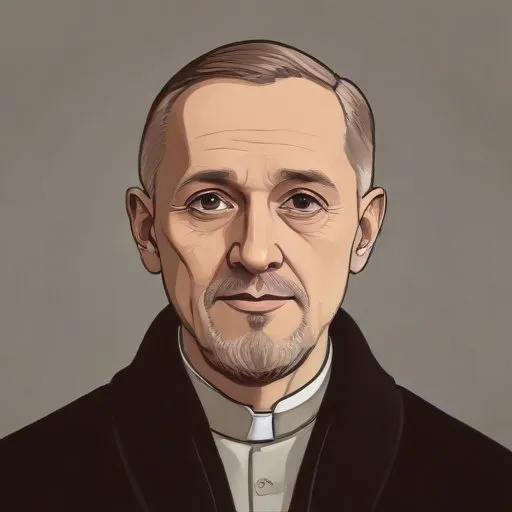
A Swiss priest and theologian who preached moral reform and was a popular pulpit orator, known for his witty sermons and critiques of church corruption.
Johann Geiler von Kaysersberg was a renowned priest and preacher of the 15th century, celebrated for his unwavering commitment to restoring Christian morals in both the Church and State. He was a prominent figure among the Renaissance humanists in Strasbourg, working closely with the likes of Jakob Wimpfeling, the esteemed "educator of Germany."
Born on March 16, 1445, in Schaffhausen, Geiler's early life was marked by tragedy when his father passed away in a hunting accident just three years later. His grandfather, who took charge of his education, sent him to school in Ammerschwihr, near Kaysersberg, where his mother resided. Geiler's academic prowess led him to the University of Freiburg in 1460, where he earned his baccalaureate in 1462 and later became Master of Arts.
Geiler's fascination with theology grew as he delved deeper into the works of Jean Gerson, prompting him to pursue a doctorate at the University of Basel in 1471. He received his doctorate in 1475 and went on to form lasting friendships with notable figures like Sebastian Brant. During his time at Basel, Geiler lectured on various theological subjects, including the Sententiae of Peter Lombard and commentaries of Alexander of Hales.
Geiler's sermons were renowned for their eloquence, conviction, and emphasis on moral reform. He advocated for the restoration of Christian morals, not through radical change, but by maintaining the doctrines of the Church. His preaching style, characterized by simplicity, clarity, and persuasive rhetoric, earned him widespread acclaim and recognition as one of the greatest preachers of the 15th century.
Although Geiler's reforms did not align with the radical spirit of Martin Luther and his adherents, his tireless efforts to restore Christian morals in Strasbourg laid the groundwork for the Protestant Reformation in the region. His impact on the Church and State was profound, making him an influential figure in shaping the course of Christian history.
Geiler's commitment to Christian morals and doctrine continues to inspire generations of theologians and scholars. His legacy serves as a testament to the power of conviction and the importance of upholding the principles of faith. In an era marked by turmoil and upheaval, Geiler's unwavering dedication to his craft left an indelible mark on the fabric of Christianity.
In conclusion, Johann Geiler von Kaysersberg's remarkable life and achievements serve as a testament to the power of conviction, moral integrity, and commitment to faith. His legacy continues to inspire and educate generations, cementing his place as one of the greatest preachers and moral reformers of the 15th century.
Born in 1483
A German monk and priest who sparked the Protestant Reformation, challenging Catholic Church authority and shaping Western Christianity. He's famous for nailing 95 theses to a church door, sparking a religious revolution.
Born in 1509
A French pastor and theologian who played a key role in the Protestant Reformation, shaping Christian theology and influencing Western civilization. He's famous for his teachings on predestination and his role in establishing Calvinism.
Born in 1484
Leader of the Swiss Reformation, advocating for church reform and inspiring other Protestant movements.
Born in 1497
A 16th-century Renaissance scholar who made significant contributions to the development of the Protestant Reformation and education, known for his theological writings and astronomical observations.
Born in 1504
A prominent figure in the Swiss Reformation, he played a key role in shaping Protestant theology and wrote influential works on covenant theology. His writings had a lasting impact on Reformed Christianity.
