


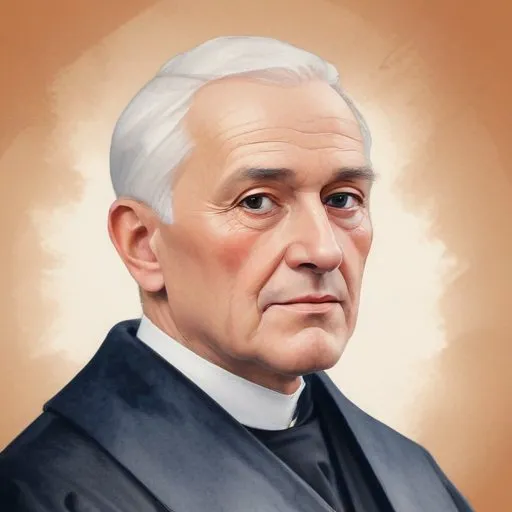
A German historian and theologian who wrote under the pseudonym "Justinus Febronius," critiquing papal authority and advocating for ecclesiastical reform .
Johann Nikolaus von Hontheim, better known by his pseudonym Febronius, was a German historian and theologian who left an indelible mark on the Catholic Church with his revolutionary treatise "On the State of the Church and the Legitimate Power of the Roman Pontiff" in 1763.
This seminal work gave rise to Febronianism, a movement that challenged the authority of the papacy and sparked a wave of reform within the Church.
Born on January 27, 1701, in Trier, Germany, Hontheim came from a noble family with strong connections to the court and government of the Electors of Trier. His father, Kaspar von Hontheim, served as the receiver-general of the Electorate.
At the tender age of 12, Hontheim received a prebend in the collegiate church of St. Simeon, courtesy of his maternal uncle, Hugo Frederick von Anethan. He went on to receive the tonsure in 1713.
Hontheim's education was undertaken by the Jesuits at Trier and at the universities of Trier, Leuven, and Leiden. He earned his doctorate in laws from the University of Trier in 1724.
The works of Zeger Bernhard van Espen, a Louvain professor, had a profound impact on Hontheim's thought process. Van Espen's Gallican doctrine, which emphasized the autonomy of national churches, resonated deeply with Hontheim and influenced his writings.
In 1728, Hontheim was ordained a priest and later became a professor of the Pandects at the University of Trier in 1732. He also served as a canon of the collegiate church of St. Simeon.
In 1738, Hontheim was sent to Coblenz to discharge official duties on behalf of the Elector. During his time in Coblenz, he played a key role in the negotiations preceding the elections of Emperors Charles VII and Francis I.
Hontheim's treatise, written under the pseudonym Febronius, was a scathing critique of papal authority. He argued that the Church should be reformed to reduce the power of the Roman Curia and increase the autonomy of national churches.
Febronianism, as the movement came to be known, gained significant traction in Europe, influencing thinkers such as Denis Diderot and Joseph II of Austria. The movement's ideas also resonated with the American and French Revolutions.
Johann Nikolaus von Hontheim's legacy extends far beyond his treatise. He is remembered as a pioneer of Catholic reform, a champion of national churches, and a fierce critic of papal authoritarianism.
As Febronius, he left an indelible mark on the Catholic Church, shaping the course of Christian reform and inspiring generations of thinkers and reformers.
Born in 1694
A witty and insightful 18th-century writer and philosopher who used satire to critique societal norms and advocate for reason, tolerance, and human rights.
Born in 1712
A pioneering thinker who shaped modern democracy and education with his ideas on social contracts, general will, and the importance of early childhood education. His writings influenced the French Revolution and modern political thought.
Born in 1724
Developed influential philosophical frameworks, such as the Critique of Pure Reason, that shaped modern Western thought on ethics, morality, and human understanding.
Born in 1729
A prominent Enlightenment thinker, he's known for his influential writings on philosophy, literature, and theology, which helped shape modern German culture. He's also credited with developing the concept of dramatic irony in literature.
Born in 1749
A German literary giant who penned iconic works like "Faust" and "The Sorrows of Young Werther", shaping the Romantic movement and influencing countless writers.
Born in 1759
A renowned poet and playwright who crafted influential works that explored the human condition, morality, and the struggle for freedom, leaving a lasting impact on German literature.
Born in 1647
A 17th-century philosopher and writer who critiqued religious intolerance and advocated for reason, skepticism, and intellectual freedom. His works influenced the Enlightenment and modern critical thinking.
Born in 1711
A Scottish Enlightenment thinker who developed influential ideas on morality, ethics, and human nature, and is considered one of the most important figures in the history of Western philosophy.
