


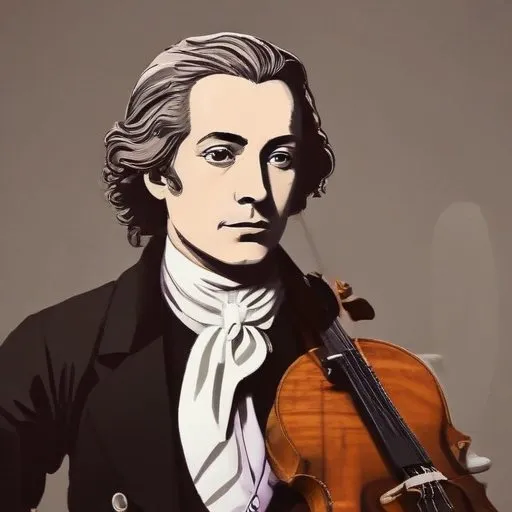
A Czech virtuoso violinist and composer who helped shape the classical symphony, contributing to the development of the Classical period's orchestral sound. His works showcase innovative harmonies and melodies.
Johann Wenzel Anton Stamitz, a renowned Czech composer and violinist, is celebrated for his crucial role in shaping the Mannheim school of music, a pivotal movement that bridged the Baroque and Classical periods. Stamitz's innovative compositions and virtuosic violin performances earned him a revered position in the 18th-century music scene, paving the way for his sons, Carl and Anton, to build upon his legacy.
Born on June 18, 1717, in Deutschbrod, Bohemia, Stamitz hailed from a family with Marburg (present-day Maribor, Slovenia) roots. His academic pursuits took him to the University of Prague, where he spent the 1734-1735 academic year. However, his passion for music soon led him to abandon his university studies and embark on a career as a violin virtuoso.
The six-year period following his departure from the university remains somewhat shrouded in mystery, but it is believed that Stamitz's connections made during the Bohemian campaign and coronation of Carl Albert (Karl VII of Bavaria) led to his appointment at the Mannheim court in 1741 or 1742. This prestigious position catapulted him to fame, with his performances enchanting the Mannheim court, including the Elector Palatine Karl Theodor.
In 1744, Stamitz married Maria Antonia Luneborn, with whom he had five children, including Carl Philipp and Anton Thadäus Nepomuk, both of whom would go on to become notable composers in their own right. During his lifetime, Stamitz made significant contributions to the world of music, publishing his Orchestral Trios, Op. 1, and other works in Paris, where he spent a year (1754-1755) refining his craft.
Stamitz's trailblazing efforts in the Mannheim school paved the way for subsequent generations of composers, solidifying his position as a pioneer in the Classical period. His music, characterized by its lyricism, melodic inventiveness, and harmonic richness, continues to inspire musicians and scholars today. As a testament to his enduring influence, Stamitz's compositions remain an integral part of classical music repertoire, ensuring his legacy endures.
Through his remarkable contributions to the world of music, Johann Stamitz has left an indelible mark on the Classical period, ensuring his legacy as the founding father of the Mannheim school continues to resonate with audiences today.
Born in 1756
A child prodigy and master of classical music, he composed over 600 works, including symphonies, operas, and chamber music, that continue to inspire and influence musicians today.
Born in 1732
A renowned composer and pianist of the Classical period, known for his symphonies, operas, and chamber music that showcased his innovative and expressive style. He played a significant role in shaping the Classical music era.
Born in 1714
A pioneering opera composer who revolutionized the art form with his innovative and expressive works, blending music and drama in a way that captivated audiences.
Born in 1782
A virtuosic violinist and composer who revolutionized the instrument's technical possibilities, leaving an indelible mark on classical music.
Born in 1770
A musical genius who expanded the possibilities of classical music, creating iconic symphonies and piano sonatas that continue to inspire and influence generations of artists.
Born in 1811
A virtuosic pianist and composer who revolutionized classical music with his technically demanding and emotionally expressive works, blending Hungarian folk influences with Romantic-era drama.
Born in 1678
A virtuosic violinist and prolific composer, he crafted over 400 concertos, including "The Four Seasons," which remains a beloved and iconic masterpiece of classical music.
Born in 1833
A renowned pianist and composer, he crafted complex, expressive works that blended traditional and innovative techniques, leaving an indelible mark on classical music.
