


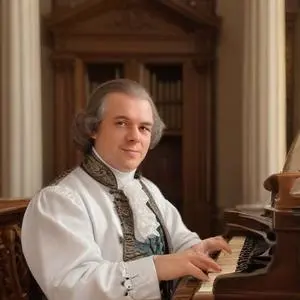
A renowned Baroque-era master of the organ and composer of intricate, innovative works that showcased his exceptional technical skill and musical genius. His contributions to the development of Western classical music are still widely revered today.
Johannes Bach, a renowned German composer and musician, is best known for his significant contributions to the Baroque period, leaving an indelible mark on the world of music. As the father of the Erfurt line of Bach family musicians, he paved the way for future generations of talented composers and musicians.
Born on November 26, 1604, in Erfurt, Germany, Johannes was the eldest son of Johannes Hans Bach and brother of Christoph Bach and Heinrich Bach. All three brothers were composers, showcasing the musical talent that ran deep in the Bach family. Johannes spent seven years studying under the tutelage of Johann Christoph Hoffmann, a stadtpfeifer in Suhl, where he honed his skills and developed his unique style.
Johannes' professional career spanned several decades, with notable positions as organist at St. Johannis church in Schweinfurt and later as town musician and director of the RathsMusikanten in Erfurt. He also served as organist at the Predigerkirche from 1636. His compositions include two motets, "Unser Leben ist ein Schatten" and "Sei nun wieder zufrieden," as well as an aria, "Weint nicht um meinen Tod."
Johannes' personal life was marked by both joy and tragedy. His first wife, Barbara Hoffman, died in 1639, shortly after giving birth to a stillborn son. He later married Hedwig Lmmerhirt, the daughter of a town councilman in Erfurt, with whom he had several children, including Johannes Christian Bach, Johann Aegidius Bach, and Johann Nicolaus Bach.
Johannes Bach's legacy extends far beyond his own lifetime. His contributions to the Baroque period have inspired generations of composers and musicians, shaping the course of music history. His works continue to be celebrated and performed today, a testament to his enduring impact on modern society.
As a member of the Bach family, Johannes was part of a rich musical heritage that spanned several generations. His unique style and compositions reflect the cultural and artistic trends of the Baroque era, providing a window into the past for modern audiences. His legacy can be seen in the many composers and musicians who followed in his footsteps, carrying on the Bach family tradition of musical excellence.
Through his remarkable life and works, Johannes Bach has left an indelible mark on the world of music. His pioneering spirit, innovative compositions, and dedication to his craft have inspired generations of musicians and continue to do so today.
Born in 1685
A master of Baroque music, he composed over 1,000 works, including orchestral suites, cantatas, and passions, that still inspire and influence musicians today. His innovative use of counterpoint and harmony raised the bar for classical music.
Born in 1685
A renowned Baroque composer and organist, famous for creating majestic orchestral suites, operas, and oratorios, including the iconic "Messiah" masterpiece.
Born in 1678
A virtuosic violinist and prolific composer, he crafted over 400 concertos, including "The Four Seasons," which remains a beloved and iconic masterpiece of classical music.
Born in 1756
A child prodigy and master of classical music, he composed over 600 works, including symphonies, operas, and chamber music, that continue to inspire and influence musicians today.
Born in 1770
A musical genius who expanded the possibilities of classical music, creating iconic symphonies and piano sonatas that continue to inspire and influence generations of artists.
Born in 1811
A virtuosic pianist and composer who revolutionized classical music with his technically demanding and emotionally expressive works, blending Hungarian folk influences with Romantic-era drama.
Born in 1810
A Polish pianist and composer renowned for his delicate, expressive, and technically demanding piano music that evokes deep emotions and continues to inspire generations of musicians and music lovers. His nocturnes, waltzes, and preludes are staples of classical music.
Born in 1810
A renowned Romantic-era composer and influential music critic, known for his expressive and emotionally charged works, including symphonies, piano music, and art songs.
