


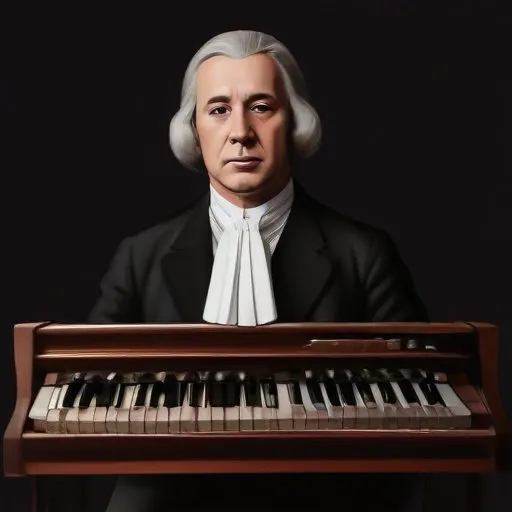
A renowned Baroque-era organist and composer, known for his intricate and expressive works that showcased his mastery of the instrument. His compositions continue to inspire and influence organ music to this day.
Heinrich Bach, a renowned German organist, composer, and member of the illustrious Bach family, left an indelible mark on the world of music. Born on September 16, 1615, in Wechmar, Germany, Heinrich was instrumental in shaping the Bach family's musical legacy, which would go on to produce some of the most iconic composers in history.
After the untimely death of his father, Heinrich's older brother Johannes Bach took on the responsibility of continuing his music education. Johannes, an accomplished musician in his own right, taught Heinrich the intricacies of organ playing. The brothers moved to Suhl and later to Schweinfurt, where they honed their craft and developed a deep appreciation for music.
In 1635, Heinrich joined the Erfurt Ratsmusikanten Compagnie, a prestigious music ensemble led by his brother Johannes. This marked the beginning of his journey as a professional musician. Six years later, in 1641, Heinrich took on the position of organist at St. Mary's Church and the Upper Church in Arnstadt, a role he would hold until his passing in 1692.
In 1642, Heinrich married Eva Hoffmann, the daughter of Suhl's Stadtpfeiffer Hoffmann. The couple had three sons, Johann Christoph Bach, Johann Michael Bach, and Johann Günther Bach, all of whom would go on to become accomplished musicians in their own right. Heinrich's sons would play a significant role in perpetuating the Bach family's musical heritage, solidifying their position as one of the most influential musical families in history.
Although few of Heinrich's compositions have survived the test of time, his works demonstrate a mastery of baroque music. His cantata "Ich danke dir, Gott," written for the 17th Sunday after Trinity, is a testament to his skill as a composer. Additionally, his "Ach, dass ich Wassers gnug hätte" and "Kyrie" showcase his ability to craft beautiful, intricate melodies.
Heinrich Bach's contributions to music extend far beyond his own compositions. As the patriarch of the Bach family, he played a crucial role in nurturing the talents of his sons, who would go on to shape the course of musical history. Johann Sebastian Bach, arguably the most famous member of the Bach family, was Heinrich's great-nephew. The legacy of Heinrich Bach continues to inspire and influence musicians to this day, making him an integral part of the rich tapestry of classical music.
Heinrich Bach's life was a testament to his passion for music and his dedication to nurturing the talents of his family. As a composer, organist, and patriarch, he played a pivotal role in shaping the Bach family's musical legacy, which continues to inspire and influence generations of musicians.
Born in 1685
A master of Baroque music, he composed over 1,000 works, including orchestral suites, cantatas, and passions, that still inspire and influence musicians today. His innovative use of counterpoint and harmony raised the bar for classical music.
Born in 1685
A renowned Baroque composer and organist, famous for creating majestic orchestral suites, operas, and oratorios, including the iconic "Messiah" masterpiece.
Born in 1660
A renowned Baroque-era organist and composer, known for his innovative and expressive works that bridged the gap between the Renaissance and Baroque styles. His compositions showcased exceptional mastery of counterpoint and harmony.
Born in 1683
A renowned Baroque composer and harpsichord virtuoso, known for his innovative and prolific output of orchestral suites, operas, and chamber music. His works showcase a unique blend of German and Italian styles.
Born in 1701
A renowned 18th-century opera composer and tenor, known for his innovative and expressive works that bridged the gap between Baroque and Classical styles. His compositions showcased exceptional vocal writing and dramatic flair.
Born in 1681
A German Renaissance man who composed music, wrote dictionaries, and served as a diplomat, making significant contributions to the fields of music theory and lexicography. He's most known for his influential music theory writings that shaped the Baroque period.
Born in 1653
A renowned Baroque composer and organist, known for blending French and Italian styles, creating complex and ornate works that showcased his mastery of counterpoint.
