


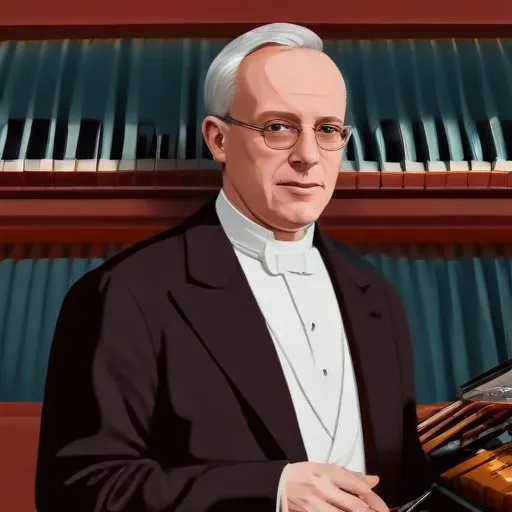
A renowned Baroque composer and organist, known for blending French and Italian styles, creating complex and ornate works that showcased his mastery of counterpoint.
Georg Muffat, a renowned Baroque composer and organist, is best known for his meticulously crafted performance directions, which accompanied his collections of string pieces, Florilegium Primum and Florilegium Secundum, in 1695 and 1698. These remarkably articulate instructions revolutionized the way musicians approached his works, providing a level of clarity and precision that was unprecedented for the time.
Born on June 1, 1653, in Megève, Duchy of Savoy (now France), Muffat was the son of Andrée Muffat of Scottish descent and Marguerite Orsyand. Between 1663 and 1669, he studied in Paris, where he was likely influenced by the prominent composer Jean Baptiste Lully, although the exact nature of their relationship remains ambiguous.
Muffat's time in Paris exposed him to the flourishing Lullian style, which he assimilated with remarkable ease. His later works would bear the unmistakable stamp of Lully's influence, showcasing a mastery of the French composer's ornate and expressive style.
After leaving Paris, Muffat held positions as an organist in Molsheim and Slestat, before studying law in Ingolstadt. Later, he settled in Vienna, where he failed to secure an official appointment, prompting him to travel to Prague in 1677 and eventually to Salzburg, where he worked for the archbishop for nearly a decade.
Around 1680, Muffat embarked on a journey to Italy, where he studied the organ with the renowned Bernardo Pasquini, a follower of Girolamo Frescobaldi's tradition. This period also saw him meet the celebrated Arcangelo Corelli, whose works he deeply admired. Muffat's exposure to Italian music and culture would profoundly shape his artistic vision, as he absorbed the country's rich musical heritage.
From 1690 until his death in 1704, Muffat served as Kapellmeister to the bishop of Passau, a position that allowed him to exercise his compositional talents and experimentation with various musical styles.
Muffat's oeuvre is characterized by a unique blend of French and Italian influences, as seen in his:
Through his compositions and performance directions, Muffat left an indelible mark on the Baroque era, informing the development of Western classical music and paving the way for future generations of composers.
Georg Muffat's remarkable legacy extends beyond his own works, as his innovative approach to performance directions has inspired generations of composers, conductors, and musicians. His dedication to precision and clarity has elevated the art of musical interpretation, ensuring his continued relevance in the world of classical music.
Born in 1632
A 17th-century mastermind who revolutionized French opera, creating lavish productions that captivated the royal court and beyond. He's credited with establishing the French opera tradition.
Born in 1653
A virtuosic violinist and composer who revolutionized the concerto grosso form, creating a new era of classical music. His influential works elevated the violin to a solo instrument, shaping the course of Western classical music.
Born in 1678
A virtuosic violinist and prolific composer, he crafted over 400 concertos, including "The Four Seasons," which remains a beloved and iconic masterpiece of classical music.
Born in 1685
A master of Baroque music, he composed over 1,000 works, including orchestral suites, cantatas, and passions, that still inspire and influence musicians today. His innovative use of counterpoint and harmony raised the bar for classical music.
Born in 1685
A renowned Baroque composer and organist, famous for creating majestic orchestral suites, operas, and oratorios, including the iconic "Messiah" masterpiece.
Born in 1685
A virtuosic harpsichordist and composer, renowned for crafting over 550 sonatas that showcased his innovative and expressive style, blending Italian and Portuguese influences. 42
Born in 1668
A renowned Baroque composer and organist, known for his intricate and expressive harpsichord music that showcased his mastery of counterpoint and ornamentation. His works continue to inspire and influence classical music today.
Born in 1659
A renowned Baroque composer, known for his iconic opera "Dido and Aeneas" and contributions to English classical music.
