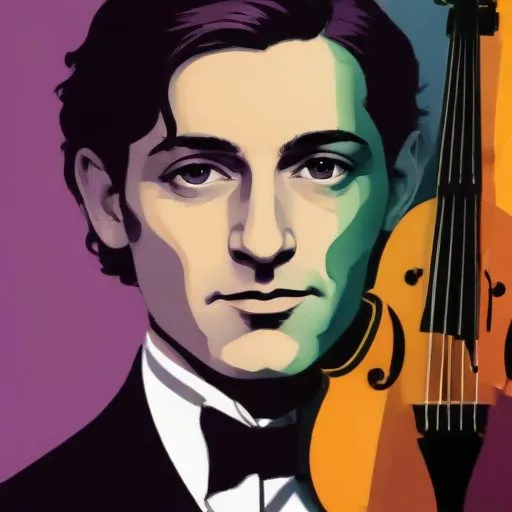
Johannes Fritsch: The Revolutionary Composer Who Shaped Modern Music
A Life of Musical Innovation
Johannes Fritsch was a German composer known for his bold and avant-garde approach to music, leaving an indelible mark on the world of contemporary composition. With a career spanning over four decades, Fritsch's work was characterized by its innovative fusion of traditional and electronic elements, pushing the boundaries of what was possible in music.
Early Life and Education
Born on July 27, 1941, in Germany, Fritsch's fascination with music began at a young age. At seven, he discovered a violin in his uncle's attic, which sparked a lifelong passion for music. He went on to study music, sociology, and philosophy at the University of Cologne, where he honed his craft under the tutelage of renowned composers
Bernd Alois Zimmermann and Gottfried Michael Koenig.
The Composer's Journey
Fritsch's compositional journey began at 17, but it was his 1962 work,
Duett für Bratsche, that brought him to the forefront of the musical scene. This innovative piece, featuring viola and tape, caused a stir at the Darmstädter Ferienkurse, earning him the reputation as a bold and daring composer.
Awards and Accolades
Throughout his career, Fritsch received numerous awards and honors, including the Förderpreis of the Federal State of North Rhine-Westphalia (1966), the Prize of the Paris Biennale (1971), and the
Robert Schumann Prize of the City of Düsseldorf.
The Feedback Studio
In 1970, Fritsch co-founded the Feedback Studio in Cologne, a pioneering institution dedicated to electronic music. As the chief protagonist of the Feedback Studio Verlag, he was instrumental in promoting the work of contemporary composers and producing innovative music.
Legacy
Fritsch's impact on modern music is undeniable. He was a true innovator, constantly pushing the boundaries of what was possible. His influence can be seen in the work of numerous composers who followed in his footsteps. Through his tireless efforts, he helped shape the course of modern music, leaving behind a legacy that continues to inspire and influence generations of musicians.
- Fritsch's music was characterized by its use of unconventional instruments and techniques.
- He was a prolific composer, with a body of work that spanned multiple genres.
- Fritsch was a champion of electronic music, and his work in this field helped pave the way for future generations of composers.
Through his remarkable life and work, Johannes Fritsch left an indelible mark on the world of music. His innovative spirit, coupled with his passion for pushing the boundaries of what was possible, continues to inspire and influence generations of musicians and composers.
FAQ
What is Johannes Fritschs background in music?
Johannes Fritsch is a German viola player and composer, born in 1941. He studied music at the University of Music and Performing Arts in Munich and began his career as a violist in the 1960s. Fritschs background in music is rooted in classical music, but he has also explored other genres.
What is Johannes Fritschs compositional style?
Johannes Fritschs compositional style is characterized by its eclecticism and experimentation. He has written works for a variety of ensembles and solo instruments, often incorporating elements of jazz, folk, and avant-garde music.
Has Johannes Fritsch collaborated with other artists?
Yes, Johannes Fritsch has collaborated with other artists, including musicians, dancers, and visual artists. He has also worked with ensembles such as the Ensemble Modern and the Arditti Quartet.
What awards has Johannes Fritsch received for his compositions?
Johannes Fritsch has received several awards for his compositions, including the German Music Publishers Award and the Composition Prize of the City of Stuttgart.
Is Johannes Fritschs music widely performed?
Yes, Johannes Fritschs music is widely performed by ensembles and soloists around the world. His compositions are often featured at festivals and concerts, and he is regarded as one of Germanys leading composers of his generation.