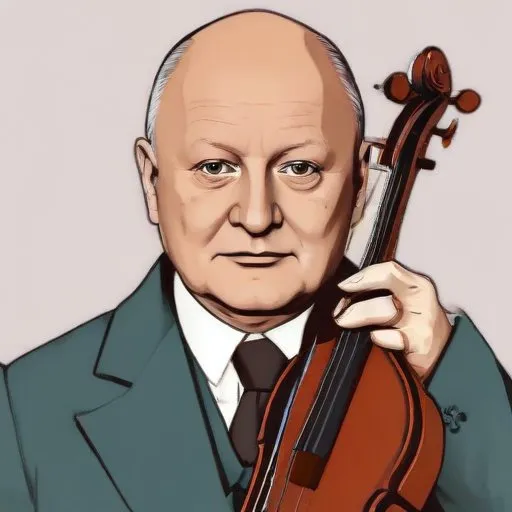
The Renowned German-American Composer: Paul Hindemith
A Master of Musical Composition and Innovation
Paul Hindemith, born on November 16, 1895, was a prolific German-American composer, music theorist, teacher, violist, and conductor who left an indelible mark on the world of classical music. He is best known for his advocacy of the Neue Sachlichkeit (New Objectivity) style of music in the 1920s, as well as his extensive contributions to the development of modern classical music.
Early Life and Career
Born in Hanau, Germany, Hindemith was the eldest child of Robert Hindemith, a painter and decorator, and Marie Hindemith (née Warnecke). He received his early musical training on the violin and later enrolled in the Dr. Hoch's Konservatorium in Frankfurt, where he studied violin with Adolf Rebner, conducting and composition with Arnold Mendelssohn and Bernhard Sekles.
The Amar Quartet and Early Success
In 1921, Hindemith founded the Amar Quartet, a string quartet that toured extensively throughout Europe, showcasing his compositions and solidifying his reputation as a master violist. His early success was marked by compositions such as Kammermusik, which embodied the neo-Bachian spirit and featured the viola and viola d'amore as solo instruments.
Neue Sachlichkeit and Musical Innovations
Hindemith's advocacy of the Neue Sachlichkeit style of music in the 1920s revolutionized the classical music landscape. This movement, characterized by its emphasis on objectivity and simplicity, sought to rid music of Romantic excesses and focus on clarity and precision. Hindemith's compositions during this period, such as his song cycle Das Marienleben (1923), showcased his unique blend of modernity and classical traditions.
Notable Compositions and Collaborations
Some of Hindemith's most notable compositions include:
- Der Schwanendreher for viola and orchestra (1935)
- The opera Mathis der Maler (1938)
- Symphonic Metamorphosis of Themes by Carl Maria von Weber (1943)
- The oratorio When Lilacs Last in the Dooryard Bloom'd (1946), a requiem based on Walt Whitman's poem
Exile and Later Years
As the Nazi regime tightened its grip on Germany, Hindemith and his wife, Gertrud, emigrated to Switzerland and eventually the United States in the late 1930s. During this period, he continued to compose, teach, and conduct, eventually becoming a naturalized American citizen in 1946.
a Musical Legacy
Hindemith's contributions to classical music are immeasurable. His emphasis on tonality, counterpoint, and musical forms has influenced generations of composers. His treatise, The Craft of Musical Composition, remains a seminal work in music theory. Hindemith's music continues to be performed and admired around the world, a testament to his enduring legacy as one of the 20th century's greatest composers.
Awards and Honors
Throughout his career, Hindemith received numerous awards and honors, including:
- The Baldwin Medal (1933)
- The Gold Medal of the National Institute of Arts and Letters (1947)
- The Grand Prize of the City of Stuttgart (1955)
Legacy in Pop Culture
Hindemith's music has appeared in various films, television shows, and stage productions, including:
- The film "The Apotheosis of Fools" (1947)
- The television show "The Twilight Zone" (1962)
Personal Life and Trivia
Hindemith was an avid collector of antique furniture and was known for his love of dogs. He passed away on December 28, 1963, leaving behind a rich musical legacy that continues to inspire and influence generations of musicians and composers.