


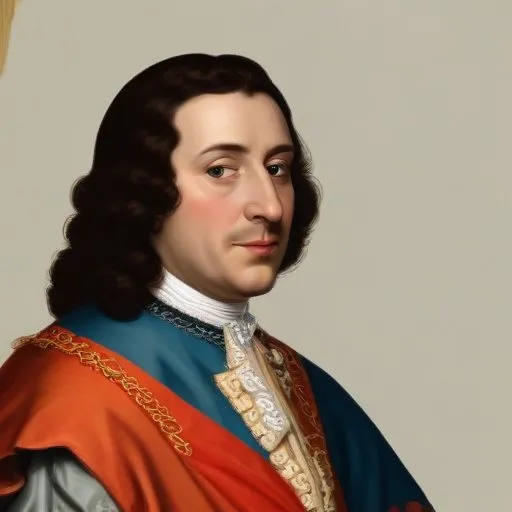
A German nobleman who ruled Nassau-Idstein and was a prominent military leader during the Thirty Years' War, known for his bravery and strategic skills. He also supported the arts and architecture in his region.
John, Count of Nassau-Idstein, was a prominent figure in 17th-century Europe, renowned for his unwavering commitment to Protestantism and his role as Regent of Idstein. Born on November 24, 1603, in Saarbrücken, John would go on to leave an indelible mark on the religious and political landscape of his time.
John was the son of Louis II, Count of Nassau-Weilburg, and his wife, Landgravine Anna Maria of Hesse-Kassel. His father, a shrewd and ambitious leader, had successfully reunified the possessions of the Walram line of the House of Nassau, including Saarbrücken, Weilburg, and Idstein. John's brothers, William Louis and Ernest Casimir, would also play important roles in shaping the course of European history.
Upon their father's death in 1627, John and his brothers divided the inheritance, with John receiving the Lordship of Idstein, Wiesbaden, and Sonnenberg. However, their territories were soon threatened by the Imperial Edict of Restitution of 1629, which sought to reclaim church properties confiscated after the Peace of Passau of 1552. The Reichskammergericht's ruling in favor of the Prince-Archbishops of Mainz and Trier put the Nassau brothers on the defensive, forcing them to fight for their rightful inheritance.
In 1629, John married Sibylla Magdalena of Baden-Durlach, a union that would strengthen his ties to the Protestant community and cement his commitment to the faith. When King Gustavus Adolphus of Sweden launched his war against the Emperor, John, along with his brothers William Louis and Ernest Casimir, joined the Protestant forces, further solidifying their reputation as champions of the faith.
John, Count of Nassau-Idstein, left a lasting legacy as a defender of the Protestant faith and a champion of religious freedom. Through his unwavering commitment to his beliefs and his bravery in the face of adversity, John inspired generations to come, solidifying his place in the annals of European history.
Born in 1650
The Prince of Orange, King of England, Scotland, and Ireland, led the Glorious Revolution, overthrowing the Catholic King James II, and ruled with his wife Mary II, establishing a Protestant monarchy. He's also known for his military victories in Ireland and Europe.
Born in 1612
Count of Nassau-Dietz, a Dutch nobleman, played a key role in the Dutch Revolt against Spanish rule and was a prominent military leader. He's known for his bravery and strategic victories.
Born in 1533
Led the Dutch Revolt against Spanish rule, establishing the Netherlands as an independent nation and paving the way for its Golden Age of prosperity and cultural flourishing.
Born in 1516
The first queen to rule England in her own right, Bloody Mary tried to restore Catholicism, earning her notorious reputation for burning hundreds of Protestants at the stake.
Born in 1683
King of Great Britain and Ireland from 1727 to 1760, known for his military victories, particularly the Battle of Dettingen, and his role in the War of the Austrian Succession.
