


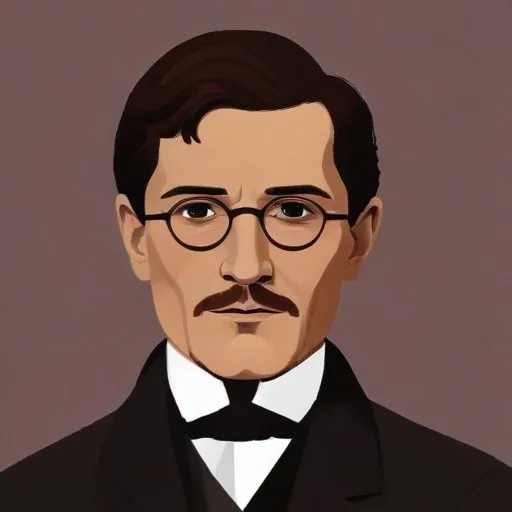
A Scottish-German philosopher and author who wrote influential works on individualist anarchism and Stirnerian egoism, and is known for his poetry and novels that explored themes of love, freedom, and nonconformity.
John Henry Mackay, a Scottish-German thinker, writer, and advocate, is best known for his egoist anarchist philosophies and his later advocacy for homosexual love between men and boys under the pseudonym Sagitta. Through his literary works, including novels such as Die Anarchisten (The Anarchists) and Der Freiheitsucher (The Searcher for Freedom), Mackay championed the ideas of philosopher Max Stirner, bringing his work to a wider audience.
Mackay was born on February 6, 1864, in Greenock, Scotland, to a Scottish marine insurance broker and a mother from a prosperous Hamburg family. After his father's death at a young age, Mackay was raised in Germany, where he developed a passion for writing and poetry. His early poems, which carried socialist sentiments, attracted the attention of censors, prompting him to republish them in Switzerland.
During a one-year stay in London (1887-1888), Mackay discovered the works of Max Stirner, which would become the focal point of his life's work. Stirner's book, Der Einzige und sein Eigenthum (The Ego and its Own), had largely been forgotten in the second half of the 19th century. Mackay's tireless efforts to promote Stirner's ideas led to the publication of an English translation of his work in 1907, bringing Stirner back into the spotlight.
Mackay's novel, Die Anarchisten (The Anarchists), published in 1891, catapulted him to fame and further solidified his reputation as a champion of Stirner's philosophies. He went on to write Max Stirner: sein Leben und sein Werk (Max Stirner: His Life and Work) in 1898, cementing his status as a leading authority on Stirner's life and ideas.
In addition to his work on Stirner, Mackay penned Der Schwimmer (The Swimmer), one of the first sports novels, which explored the world of competitive swimming and diving. This novel, published in 1901, showcased Mackay's versatility as a writer and his ability to tackle diverse subjects.
Under the pseudonym Sagitta, Mackay became an advocate for homosexual love between men and boys, a controversial stance at the time. This marked a significant shift in his literary focus, as he began to explore themes of love, desire, and human relationships.
In his later years, Mackay continued to write and champion the causes close to his heart. He remained dedicated to promoting Stirner's philosophies and advocating for the acceptance of homosexuality, leaving behind a legacy as a bold and unapologetic thinker.
John Henry Mackay's contributions to literature, philosophy, and social discourse are undeniable. Through his tireless advocacy for Max Stirner's ideas, he brought attention to a previously forgotten philosopher, ensuring his work would endure for generations to come. Mackay's own literary works, including his novels and poetry, offer a unique perspective on the human experience, exploring themes of love, desire, and individual freedom.
As a champion of egoist anarchism and a passionate advocate for homosexual love, Mackay's legacy serves as a testament to the power of bold ideas and unyielding conviction. His life and works continue to inspire and provoke, offering a glimpse into a world where individual freedom and human connection are paramount.
John Henry Mackay's remarkable life and literary contributions have left an indelible mark on the world of philosophy, literature, and social discourse. As a champion of egoist anarchism and a passionate advocate for human connection, Mackay's legacy serves as a beacon of inspiration, challenging us to embrace our individuality and strive for a world where love and freedom know no bounds.
Born in 1806
A 19th-century philosopher who rejected all forms of authority and advocated for individualism, arguing that people should prioritize their own interests and desires above all else.
Born in 1817
A 19th-century thinker who advocated for simple living, civil disobedience, and individualism, inspiring generations to reevaluate their relationship with nature and society.
Born in 1803
A leading figure in the Transcendentalist movement, he advocated for individualism, self-reliance, and nature-inspired spirituality through his essays and poetry. His ideas continue to influence American thought and culture.
Born in 1819
A celebrated poet, essayist, and journalist who revolutionized American literature with his collection "Leaves of Grass", known for his free verse style and celebration of the human spirit.
Born in 1854
A witty and flamboyant literary mastermind, renowned for crafting clever, humorous, and poignant works that continue to delight audiences with their clever wordplay and societal commentary.
Born in 1844
A pioneering anthologist and poet who championed socialism, homosexuality, and Eastern philosophy, compiling influential collections of folk songs and poetry. His works explored themes of love, nature, and social justice.
Born in 1869
A Lithuanian-Canadian philosopher and activist who advocated for anarchism, free speech, and women's rights, playing a pivotal role in shaping modern feminist and political thought.
