


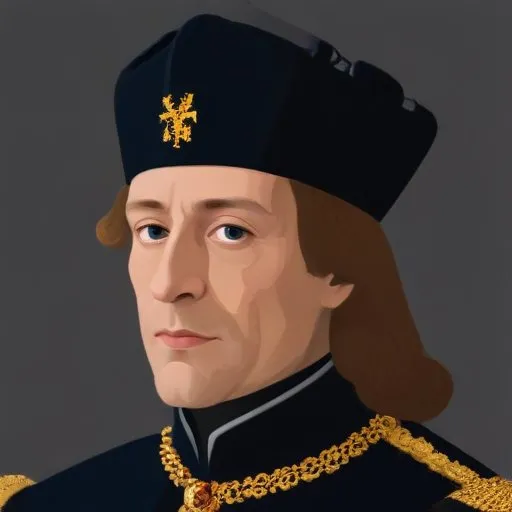
A 16th-century Danish nobleman who ruled a duchy in southern Jutland, known for his role in the Count's Feud, a civil war that shaped Denmark's history.
John II, Duke of Schleswig-Holstein-Haderslev, was a prominent figure in 16th-century Europe, renowned for his progressive reforms, dedication to education, and unwavering commitment to the Protestant Reformation. As the only Duke of Schleswig-Holstein-Haderslev, John left an indelible mark on the regions of Schleswig, Holstein, and Haderslev, earning himself a place in the annals of history.
Born on June 29, 1521, in Haderslev, John was the son of King Frederick I of Denmark and his second wife, Sophie of Pomerania. As a potential heir to the throne, John received a meticulous education, which included several years at the court of his brother-in-law, Albert, Duke of Prussia, in Königsberg. This exposure to the secular state of Prussia would later shape John's understanding of politics and statecraft.
From 1544, John ruled the duchies of Schleswig and Holstein jointly with his brother, Adolf of Denmark, and his half-brother, King Christian III of Denmark. He governed from Haderslevhus Castle and later built Hansborg Castle, a magnificent Renaissance palace in his hometown. John's territory comprised the Counties of Haderslev, including Tønder, Tønning, and Løgumkloster, as well as the islands of Nordstrand and Fehmarn in Schleswig, and Rendsburg and smaller communities in Holstein.
A devout adherent of the Protestant Reformation, John introduced numerous reforms to his territories, including the establishment of several social and educational institutions. Notably, he founded the Duke John Hospital in Haderslev, a testament to his commitment to the welfare of his people. John's progressive stance earned him respect and admiration from his contemporaries, solidifying his position as a leader in the Protestant movement.
John's dedication to justice and education led to significant reforms in the legal system. He introduced measures to improve the administration of justice, earning him a reputation as a fair and dedicated judge. Additionally, John founded schools and institutions of higher learning, fostering a culture of intellectual curiosity and religious tolerance.
John II, Duke of Schleswig-Holstein-Haderslev, left an enduring legacy in the regions he governed. His commitment to the Protestant Reformation, education, and social welfare set a precedent for future generations of leaders. As a champion of progress and a dedicated ruler, John's name remains synonymous with vision, reform, and wisdom.
Through his life's work, John demonstrated that even in tumultuous times, a leader could champion the cause of his people, while remaining true to his convictions. His story serves as a testament to the power of visionary leadership, inspiring generations to come.
Born in 1749
King of Denmark and Norway from 1766 to 1808, known for his mental health issues and scandals, which led to a regency that ruled in his place.
Born in 1723
King of Denmark and Norway from 1746 to 1766, known for his cultural and economic reforms, as well as his patronage of the arts.
Born in 1749
King of Denmark and Norway from 1766 to 1808, known for his mental health issues and scandals, which led to a regency that ruled in his place.
Born in 1511
Queen consort of Denmark and Norway, married to Christian III, played a significant role in promoting the Lutheran Reformation and was a patron of the arts. She was a strong advocate for education and women's rights.
Born in 1609
King of Denmark and Norway from 1648 to 1670, known for establishing absolute monarchy and modernizing Denmark's administration.
