


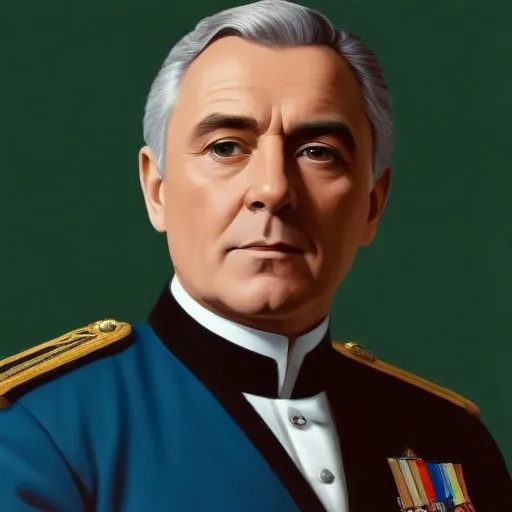
Irish general and politician who served as Governor of Saint Lucia, known for his military campaigns in the Napoleonic Wars and his role in the British colonial administration.
John Keane, 1st Baron Keane, is renowned for his valiant military prowess, which earned him the esteemed title of Baron Keane of Ghuznee in the First Anglo-Afghan War. This remarkable Irish soldier's bravery and strategic brilliance led to the British Empire's triumph in the treacherous terrain of Afghanistan, cementing his place in history as a hero and a legend.
Born on February 6, 1781, in Waterford, Ireland, John Keane was the second son of John Keane of Cappoquin and his wife, Sarah Kelly. His father was later created a baronet in 1801. Keane's family was steeped in military tradition, with his elder brother, Lt. Col. Sir Richard Keane, 2nd Baronet, and younger brother, Col. Edward Keane, also pursuing distinguished military careers.
Keane's military journey began on October 11, 1794, when he joined the British Army as an ensign in the 122nd Regiment of Foot. His rapid ascension through the ranks was a testament to his exceptional abilities, becoming a lieutenant on October 30, and subsequently, a captain in the 124th Regiment of Foot on November 12. Although the 124th was disbanded in May 1795, Keane seamlessly transferred to the half-pay of the 73rd Regiment of Foot.
In November 1799, Keane exchanged into the 44th Regiment of Foot, which was stationed in Gibraltar. He accompanied the regiment to Egypt, where he fought bravely as aide-de-camp to Lord Cavan in the Battle of Mandora on March 13, 1801, and the Battle of Alexandria on March 21. After the French capitulation in September, Keane went to Malta as a staff officer, where he remained until March 1803, when he returned to England.
Keane's most notable achievement came during the First Anglo-Afghan War, when he led the British forces to a stunning victory in the Battle of Ghuznee on July 21, 1839. This triumph earned him the title of Baron Keane of Ghuznee and cemented his status as a military hero.
In recognition of his outstanding service, Keane was created a baron in 1839, and later, a Knight Commander of the Order of the Bath (KCB) in 1842. His name became synonymous with military excellence, inspiring generations of soldiers and solidifying his place in the annals of history.
Throughout his illustrious career, Keane demonstrated unwavering dedication and unrelenting passion for his work. His personal milestones serve as a testament to his remarkable character, including his promotion to lieutenant-general in 1828 and his appointment as colonel of the 44th Regiment of Foot in 1837.
John Keane, 1st Baron Keane, passed away on August 24, 1844, leaving behind a legacy of courage, honor, and military genius that continues to inspire and captivate generations to this day.
Born in 1769
A renowned military leader who defeated Napoleon at the Battle of Waterloo, and later served as Prime Minister of the United Kingdom, shaping the country's politics and history.
Born in 1620
A 17th-century Lord Mayor of London who played a significant role in the city's financial and economic development, particularly in the rebuilding of London after the Great Fire of 1666.
Born in 1764
A British Army general who led the Light Division during the Peninsular War, known for his bravery and tactical genius. He was also a Member of Parliament for several constituencies.
Born in 1768
A prominent military leader and politician, he played a crucial role in the Battle of Waterloo and later served as Lord Lieutenant of Ireland, shaping the country's politics and governance.
