


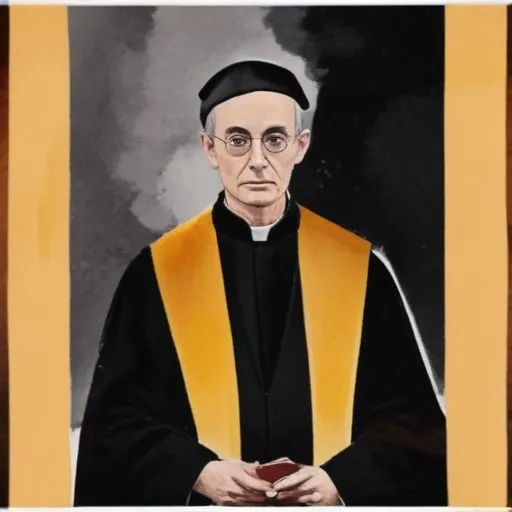
A 17th-century Anglican priest and scholar who made significant contributions to biblical studies, particularly in the field of Hebraic studies and biblical chronology.
John Lightfoot, a 17th-century English churchman and renowned rabbinical scholar, is best known for his profound contributions to the Westminster Assembly, a pivotal event in Christian history. His meticulous research, oratory skills, and unwavering dedication to biblical scholarship earned him a revered position among his contemporaries.
Born in Stoke-on-Trent on March 29, 1602, John Lightfoot was the son of Thomas Lightfoot, a vicar of Uttoxeter, Staffordshire. He received his early education at Morton Green, near Congleton, Cheshire, before attending Christ's College, Cambridge, where he excelled as an orator among his peers.
After taking orders, Lightfoot served as assistant master at Repton School in Derbyshire and later became curate of Norton-under-Hales in Shropshire. His exceptional skills caught the attention of Sir Rowland Cotton, an amateur Hebraist, who appointed him as his domestic chaplain at Bellaport.
Lightfoot's most notable work, A Few and New Observations upon the Book of Genesis, showcases his meticulous research and innovative approach to biblical scholarship. This work, along with his Journal of the Proceedings of the Assembly of Divines, provides valuable insights into the Westminster Assembly and its significance in Christian history.
As one of the original members of the Westminster Assembly, Lightfoot played a crucial role in shaping the discussions and outcomes of this pivotal event. His assiduous attendance and unwavering stance on various issues, including the Erastian controversy, demonstrate his commitment to biblical scholarship and his influence on the Assembly's proceedings.
John Lightfoot's contributions to biblical scholarship and his involvement in the Westminster Assembly have had a lasting impact on Christian theology and practice. His work continues to influence contemporary scholars, theologians, and church leaders, ensuring his legacy as a prominent figure in Christian history.
John Lightfoot's life and works are a testament to his unwavering dedication to biblical scholarship and his significant contribution to the Westminster Assembly. His legacy continues to inspire and inform contemporary Christian theology and practice, ensuring his place as a prominent figure in Christian history.
John Lightfoot's remarkable life and achievements serve as a testament to his profound impact on Christian history, cementing his place as a revered figure in the realm of biblical scholarship and theology.
Born in 1584
A renowned 17th-century jurist and scholar who made significant contributions to the fields of law, history, and literature, earning him a reputation as one of the most learned men of his time.
Born in 1581
An Irish archbishop and historian who calculated the exact date of creation as October 23, 4004 BCE, and wrote extensively on biblical chronology. His works remain influential in Christian theology.
Born in 1593
A metaphysical poet and Anglican priest, he crafted intricate, symbolic, and introspective verse that explored the human condition and spirituality. His poetry is revered for its lyricism, depth, and emotional resonance.
Born in 1627
Pioneering scientist who discovered Boyle's Law, which describes the relationship between pressure and volume of gases, and laid foundations for modern chemistry.
Born in 1656
Predicted celestial events, including the return of a comet that bears his name, and made significant contributions to navigation, astronomy, and mathematics.
Born in 1898
A pioneer of modern sculpture, creating abstract, biomorphic forms that evoke a sense of primal emotion, and illustrating books with whimsical, dreamlike drawings.
