


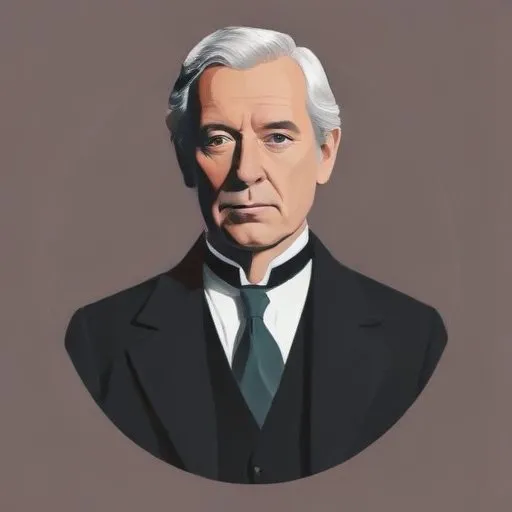
A 19th-century British politician who served as Prime Minister of the United Kingdom, known for his role in passing the Reform Act of 1832, which expanded voting rights. He was a key figure in shaping the country's liberal politics.
John Russell, 1st Earl Russell, is renowned for his pivotal role in shaping the course of British politics, earning him the distinction of being one of the most influential statesmen of the 19th century. He is perhaps best known for his tireless efforts in advocating for the Reform Act of 1832, which marked a significant milestone in the journey towards democracy and the expansion of voting rights.
Russell was born on August 18, 1792, to the 6th Duke of Bedford, and was educated at Westminster School and Edinburgh University. His formative years instilled in him a strong sense of social responsibility and a commitment to public service.
Russell's ministerial career spanned an impressive four decades, during which he served in the cabinets of Earl Grey, Viscount Melbourne, the Earl of Aberdeen, and Viscount Palmerston. His relationships with these prominent figures were often tumultuous, but ultimately contributed to the formation of the united Liberal Party, which would go on to dominate British politics in the following decades.
While Russell's tenure as Prime Minister was marked by controversy and challenges, his contributions to the development of British democracy cannot be overstated. He played a crucial role in shaping the country's political landscape, paving the way for future generations of reformers and politicians.
Russell's personal relationships were often complex and multifaceted. His unlikely alliance with Viscount Palmerston, despite their frequent disagreements, was a testament to his ability to forge unlikely partnerships and drive political progress.
In the context of British history, Russell's reforms and advocacies played a significant role in shaping the country's transition from an aristocratic oligarchy to a more democratic system. His commitment to social justice and equality inspired a new generation of politicians and reformers, cementing his place as one of the most important figures of the 19th century.
Today, John Russell, 1st Earl Russell, is remembered as a champion of democracy, a champion of the people, and a testament to the power of dedicated public service.
Born in 1804
A skilled politician who served as Prime Minister of the United Kingdom, known for his influential role in shaping the country's politics and economy during the 19th century.
Born in 1819
The monarch who ruled the British Empire for 63 years, overseeing the Industrial Revolution and expanding the empire's reach, earning the nickname "the Grandmother of Europe".
Born in 1788
A British politician who served as Prime Minister and is credited with establishing the modern police force and repealing the Corn Laws, a major trade restriction. He's also known for his role in shaping the Conservative Party.
Born in 1812
A renowned author of timeless classics, crafting vivid stories that exposed social injustices and explored the human condition, leaving an indelible mark on literature.
Born in 1820
Pioneering nurse and statistician who revolutionized healthcare by introducing sanitation practices and data-driven decision making, becoming the founder of modern nursing.
Born in 1791
Pioneering scientist who discovered electromagnetic induction, formulated the laws of electrolysis, and invented the first electrical generator, revolutionizing our understanding of electricity and its applications.
