


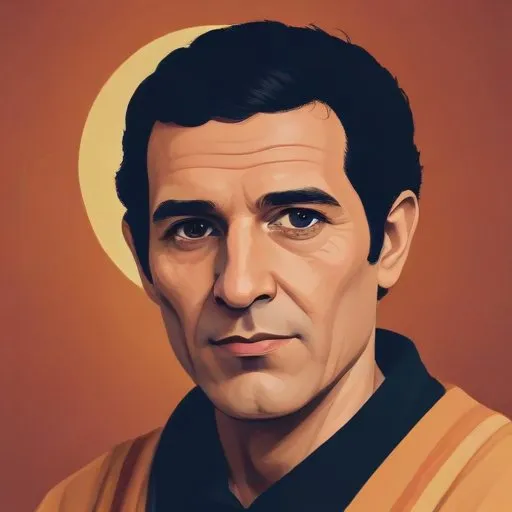
Greek-South African astronomer and academic who made significant contributions to the field of astronomy, particularly in the discovery of celestial objects and the development of astronomical instruments.
John S. Paraskevopoulos, fondly known as John Paras, was a renowned Greek and South African astronomer who made significant contributions to the field of astronomy, particularly in the discovery of comets and the establishment of observatories in South Africa.
Born on June 20, 1889, in Piraeus, Greece, Paraskevopoulos graduated from the University of Athens with a PhD in physics in 1910, under the supervision of Timoleon A. Argyropoulos. His thesis, "Variability in absorption spectra", showcased his exceptional academic prowess.
Paraskevopoulos' career was marked by several notable milestones. He served in the Greek army during the Balkan Wars and World War I, and later worked as an assistant to Prof. Demetrios Eginitis at the National Observatory of Athens. In 1919, he received a two-year fellowship to work at Yerkes Observatory in the United States, where he met his future wife, Dorothy W. Block.
Upon his return to Athens in 1921, he became the head of the astronomy department at the National Observatory of Athens, with a vision to build a large telescope in Greece. However, due to the war between Greece and Turkey, this dream never materialized.
In 1923, Paraskevopoulos accepted an offer from Dr. Harlow Shapley to become the Superintendent of the Harvard Observatory's Southern Station. However, due to a lack of funding, he moved to Arequipa, Peru to work at Boyden Station, a branch of Harvard Observatory. The decision was made to move Boyden Station to South Africa due to better weather conditions, and Paraskevopoulos served as the director of Boyden Observatory in South Africa from 1927 to 1951.
One of Paraskevopoulos' most notable achievements was the co-discovery of two comets, including C/1941 B2 (de Kock-Paraskevopoulos), which was visible to the naked eye. The Paraskevopoulos crater on the Moon is named in his honor, a testament to his significant contributions to the field of astronomy.
Paraskevopoulos passed away on March 15, 1951, leaving behind a legacy of scientific achievements and contributions to the field of astronomy. His life's work serves as an inspiration to future generations of astronomers and scientists.
John S. Paraskevopoulos' remarkable journey is a testament to his dedication to the field of astronomy. His contributions to the discovery of comets, the establishment of observatories in South Africa, and his legacy continue to inspire future generations of scientists and astronomers.
Born in 1473
A Renaissance-era mathematician and astronomer who proposed the heliocentric model, where the Sun is at the center of our solar system, revolutionizing our understanding of the universe.
Born in 1564
Pioneering astronomer, physicist, and mathematician who played a major role in the Scientific Revolution, making key discoveries that challenged Aristotelian views and laid the foundation for modern science.
Born in 1571
A 17th-century trailblazer who discovered the three laws of planetary motion, revolutionizing our understanding of the solar system. He's also credited with being a pioneer in the field of astrology.
Born in 1738
A pioneering astronomer and musician who discovered Uranus and two of its moons, and also composed symphonies and concertos.
Born in 1811
Predicted the existence and location of Neptune, a previously unknown planet, through mathematical calculations, revolutionizing astronomy.
Born in 1885
Measured the galaxy's size and mapped the Milky Way's structure, revolutionizing our understanding of the universe.
Born in 1889
Discovered galaxies beyond our own Milky Way, revolutionizing our understanding of the universe's scale and expansion. Pioneered observational cosmology, providing evidence for the Big Bang theory.
