


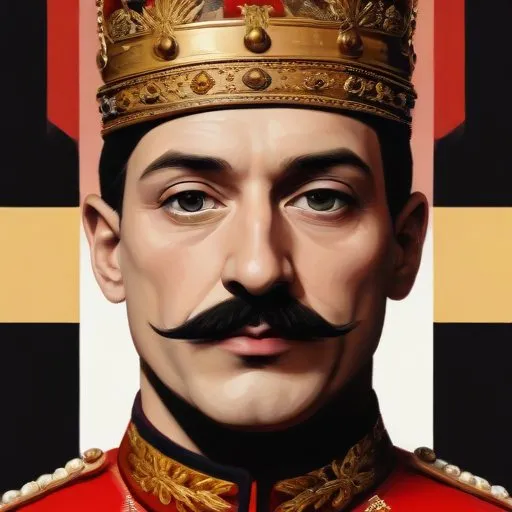
The King of Hungary who ruled from 1540 to 1570, known for his attempts to unite Hungary and Transylvania under a single rule, and his role in the Ottoman-Habsburg rivalry.
John Sigismund Zpolya, also known as Szapolyai, is renowned as the King of Hungary from 1540 to 1551 and again from 1556 to 1570, as well as the first Prince of Transylvania from 1570 until his death in 1571. His life was marked by a constant struggle for power, legitimacy, and survival amidst the tangled web of Ottoman-Hungarian politics.
Born on July 7, 1540, John Sigismund was the only son of John I, King of Hungary, and Isabella of Poland. His father's deathbed wish was for John Sigismund to inherit the throne, which was met with opposition from Ferdinand I of Habsburg, who ruled Austria and Bohemia. Despite this, John Sigismund's supporters elected him king, although he was not crowned with the Holy Crown of Hungary.
The Ottoman Sultan Suleiman I, under the pretext of protecting John Sigismund from Ferdinand, invaded Hungary in 1541, and the capital city of Buda fell without resistance. Suleiman allowed John Sigismund's mother, Isabella, to retain control of the territory east of the Tisza River on her son's behalf. The dowager queen and John Sigismund were eventually forced into exile, settling in Poland.
After a brief period of exile, John Sigismund and his mother returned to Transylvania, where she ruled his realm until her death in 1559. John Sigismund continued to negotiate with Ferdinand's enemies, seeking to regain control of his kingdom. His efforts were eventually successful, and he was restored as King of Hungary in 1556.
John Sigismund Zpolya's life was a testament to the complexities of power struggles and diplomatic intrigue in 16th-century Europe. His story serves as a reminder of the enduring legacy of the Hungarian monarchy and its connections to the Ottoman Empire. Through his tumultuous reign, John Sigismund navigated the treacherous landscape of royal politics, leaving behind a lasting impact on the history of Hungary and Transylvania.
John Sigismund's life and reign are often seen in the context of the wider Ottoman-Hungarian conflicts of the 16th century. His struggles for power and legitimacy can be compared to those of his contemporaries, such as Ferdinand I of Habsburg and Suleiman the Magnificent. A closer examination of John Sigismund's life reveals the intricate web of alliances and rivalries that shaped the course of European history during this period.
Through his story, we are afforded a glimpse into the complex dynamics of royal power, diplomatic intrigue, and the enduring legacy of the Hungarian monarchy. John Sigismund Zpolya's life serves as a testament to the enduring power of royal ambition and the intricate tapestry of European politics in the 16th century.
Born in 1558
The last Archduke of Austria, a Habsburg ruler who played a key role in the Austro-Hungarian Empire's decline, and is remembered for his attempts to reform the empire and prevent its downfall.
Born in 1456
King of Hungary and Croatia from 1490 to 1516, known for his attempts to strengthen the Hungarian monarchy and defend against Ottoman Empire expansion.
Born in 1326
King of Hungary and Poland who ruled with an iron fist, expanding his kingdom and establishing a strong centralized government. He's also known for his military campaigns against the Ottoman Empire.
