


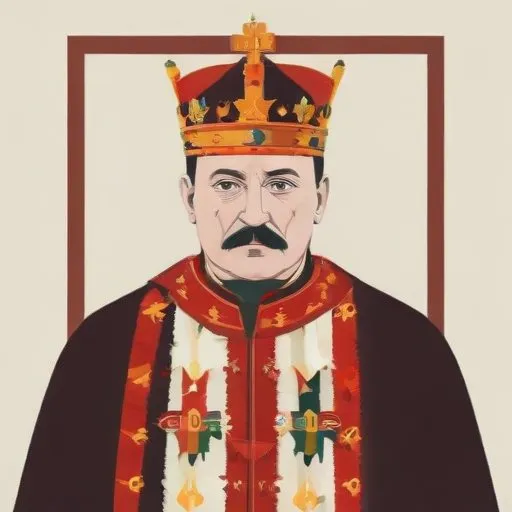
King of Hungary and Croatia from 1490 to 1516, known for his attempts to strengthen the Hungarian monarchy and defend against Ottoman Empire expansion.
Vladislaus II, also known as Vladislav or Wladyslas, was a prominent figure in Central European politics, reigning as King of Bohemia from 1471 to 1516 and King of Hungary and Croatia from 1490 to 1516. He is remembered for his shrewd diplomacy, strategic alliances, and military prowess, which enabled him to maintain a delicate balance of power in the region.
Vladislaus was born on March 1, 1456, as the eldest son of Casimir IV Jagiellon, the King of Poland and Grand Duke of Lithuania. Following the death of George of Poděbrady, the Hussite ruler of Bohemia, Vladislaus was offered the throne by the Bohemian Diet in 1468.
Vladislaus's reign was marked by a prolonged struggle with Matthias Corvinus, the powerful King of Hungary. The two monarchs vied for control over Bohemia, Moravia, Silesia, and Lusatia, with Vladislaus ultimately agreeing to the Peace of Olomouc in 1479. This treaty divided the Crown of Bohemia between the two rulers, with Vladislaus ruling Bohemia proper and Matthias controlling the surrounding territories.
In 1483, Vladislaus faced a rebellion in Prague and other towns, forcing him to acknowledge the dominance of the Hussites in the municipal assemblies. Two years later, the Diet confirmed the right of the Bohemian noblemen and commoners to adhere freely to Hussitism or Catholicism. This landmark decision fostered an era of relative religious tolerance and stability in Bohemia.
Following Matthias Corvinus's death in 1490, Vladislaus laid claim to Hungary and was elected king by the Diet. He successfully defended his claim against rival claimants, including Maximilian of Habsburg and his own brother, John Albert. Vladislaus's reign in Hungary was marked by a series of successful military campaigns, which expanded his territories and solidified his position as a dominant force in Central European politics.
Vladislaus II's reign had a profound impact on the development of Central Europe. His ability to navigate complex alliances and maintain a delicate balance of power helped to prevent the region from descending into chaos. Furthermore, his promotion of religious tolerance and his willingness to compromise with rival claimants set a precedent for future generations of leaders.
Vladislaus II's reign coincided with a period of significant upheaval in Central Europe, marked by the rise of powerful monarchies and the decline of the Holy Roman Empire. In contrast to his contemporaries, such as Matthias Corvinus and Maximilian of Habsburg, Vladislaus is notable for his pragmatic approach to politics and his willingness to compromise in order to maintain stability and promote his interests.
Through his shrewd diplomacy, military prowess, and commitment to religious tolerance, Vladislaus II left a lasting legacy that continues to shape the course of Central European politics to this day.
Born in 1409
The Queen of Hungary and Poland from 1370 to 1382, known for her diplomatic skills and efforts to maintain peace and stability in Central Europe.
Born in 1262
King of Hungary and Croatia from 1272 to 1290, known for his tumultuous reign marked by power struggles, wars, and a decline in royal authority.
Born in 1420
The King of Bohemia who ruled from 1458 to 1471, known for his attempts to reform the Catholic Church and his role in the Bohemian Wars.
Born in 1443
Renaissance-era king who ruled Hungary and Croatia, known for his military campaigns, cultural achievements, and patronage of arts and education. He transformed his kingdom into a major power in Central Europe.
