


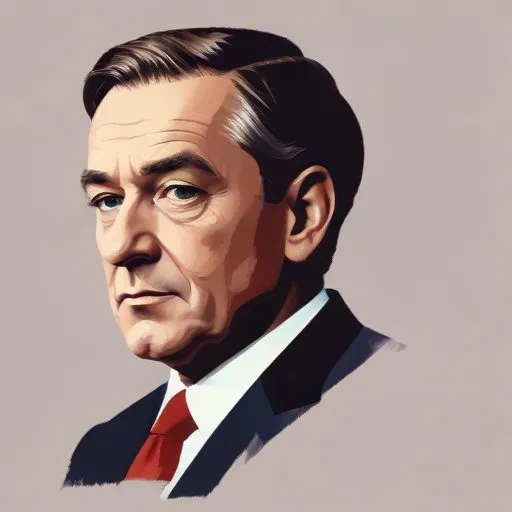
A Whig politician who served as Secretary of State for the Northern Department, known for his strong anti-Catholic stance and advocacy for British involvement in European affairs.
Sir John Trenchard, an English politician and landowner, is known for his tumultuous life, oscillating between loyalty to the crown and rebellious inclinations. Born on March 30, 1649, Trenchard's journey was marked by controversy, intrigue, and a pursuit of power in 17th-century England.
Trenchard belonged to an old Dorset family, with his father, Thomas Trenchard, and grandfather, Sir Thomas Trenchard, knighted by James I in 1613. He received his education at Winchester (1661-1665) and New College, Oxford (1665-1667). After entering the Middle Temple in 1667, he was called to the bar in 1674.
In 1679, Trenchard entered Parliament as a member for Taunton, where he associated himself with those who proposed to exclude the Duke of York from the throne. Although arrested in 1683 for suspected involvement in the Rye House Plot, he was released due to lack of evidence. This close call did not deter him; instead, he fled to Groningen, Netherlands, after Monmouth's rebellion in 1685. Through the intervention of William Penn, Trenchard received a pardon and returned to England in 1687-1688.
His loyalty to the crown was rewarded when he was knighted by King William III on October 29, 1689, and appointed Chief Justice of Chester. In 1692, he became Secretary of State, solidifying his position in the new government.
However, Trenchard's tenure as Secretary of State was marred by controversy. He, along with the government, faced ridicule for their failure to prove the existence of a Jacobite plot in Lancashire and Cheshire. This blunder damaged his reputation and credibility.
On November 10, 1682, Trenchard married Philippa Speke, daughter of George and Mary Speke of White Lackington, Somerset. The couple had four sons and three daughters, including George Trenchard, Maria Trenchard, and William Trenchard. Tragically, Sir John died on April 27, 1695, at Kensington, London, due to tuberculosis. He was buried at Lytchett Matravers, near Poole.
Through his tumultuous life, Sir John Trenchard navigated the complexities of 17th-century English politics, oscillating between loyalty and rebellion. His legacy serves as a testament to the intrigue and drama of the era, leaving behind a trail of controversy and intrigue.
Born in 1676
The first Prime Minister of the United Kingdom, serving from 1721 to 1742, known for establishing the office of Prime Minister and setting important precedents for the role. He is also recognized for his skill in managing Parliament and his role in shaping British politics.
Born in 1694
The Prime Minister who led Britain through a period of relative peace and stability, and is often credited with being the first Prime Minister in the modern sense, holding office from 1743 to 1754.
Born in 1712
A skilled lawyer and politician who served as Prime Minister of Great Britain, known for implementing the Stamp Act, a taxation policy that sparked American colonial resistance.
Born in 1749
A prominent 18th-century politician who championed individual liberties and opposed British imperialism, known for his charismatic oratory skills and influential foreign policy decisions.
Born in 1759
Prime Minister of the United Kingdom from 1783 to 1801 and 1804 to 1806, known for leading the country through the French Revolutionary and Napoleonic Wars.
Born in 1725
Chancellor of the Exchequer who imposed taxes on British American colonies, sparking widespread protests and contributing to the American Revolution.
