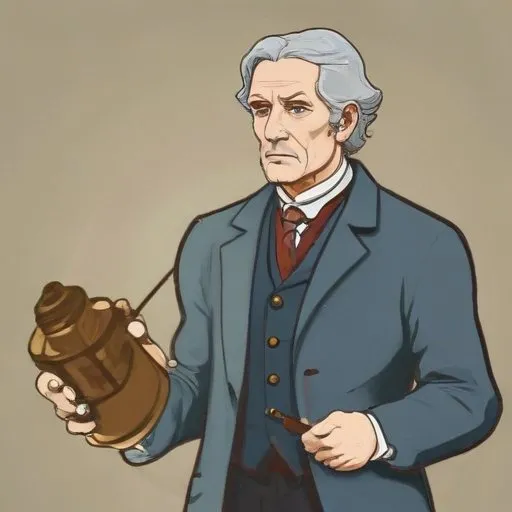
John Whitehurst

John Whitehurst

John Whitehurst was born on April 10th, 1713

Full Name: John Whitehurst
Nationality: English
Occupations: Geologist, Clockmaker
Birth Year: 1713
Birth Place: Congleton, England
Died: 1788
Notable Work: Inquiry into the Original State of the Earth
Fields: Geology, Horology

A pioneering geologist and clockmaker who made significant contributions to the field of geology, particularly in the study of fossils and the formation of the Earth's crust.

Written by: Isabel Sanchez Isabel Sanchez

John Whitehurst: The Clockmaker Who Revolutionized Geology

Meet John Whitehurst, a renowned clockmaker and scientist who made significant contributions to the field of geology. Born on April 10, 1713, in Congleton, Cheshire, England, Whitehurst's innovative work in mechanics, pneumatics, and hydraulics laid the foundation for his groundbreaking geological theories.

A Self-Taught Genius

Despite receiving only a slight formal education, Whitehurst's curiosity and passion for knowledge led him to learn clockmaking from his father. This early training sparked a lifelong fascination with mechanics and instruments, which later influenced his geological pursuits.

Career Highlights and Major Works

A Pioneering Geologist

Whitehurst's most notable contribution to science was his theory on geological strata, which he published in 1778 in his book, An Inquiry into the Original State and Formation of the Earth. This work laid the foundation for modern geological understanding, making him a pioneer in the field.

The Invention of the Pulsation Engine

In 1772, Whitehurst invented the pulsation engine, a water-raising device that preceded the hydraulic ram. This innovative contraption demonstrated his mastery of mechanical engineering and his ability to apply scientific principles to real-world problems.

Personal Milestones and Key Life Events

Legacy and Impact

John Whitehurst's contributions to geology, mechanics, and pneumatics have had a lasting impact on modern science. His work continues to inspire and influence scientists, engineers, and innovators to this day, cementing his place in the annals of scientific history.

Timeline
1713
Born in Congleton
John Whitehurst was born in Congleton, England, to a family of clockmakers and inventors.
1736
Apprentices with clockmaker
Whitehurst apprenticed with a clockmaker in London, where he developed skills in precision engineering.
1757
Publishes Inquiry into the Original State
Whitehurst published Inquiry into the Original State of the Earth, a geological treatise that explored the formation of the Earth.
1774
Elected as Fellow of Royal Society
Whitehurst was elected as a Fellow of the Royal Society, recognizing his contributions to science and engineering.
1788
Dies in London
Whitehurst passed away in London, leaving behind a legacy as a pioneering geologist and clockmaker.
John Whitehurst

John Whitehurst Quiz

What was John Whitehurst's primary profession?

Score: 0/5
FAQ
What was John Whitehursts contribution to geology?
John Whitehurst was a pioneering geologist who made significant contributions to the field, particularly in the study of fossils and the classification of rocks.
What is John Whitehurst famous for?
John Whitehurst is famous for his work on the formation of the Earths crust, and his book Inquiries into the Original State of the Earth is considered a foundational text in the field of geology.
What was John Whitehursts occupation besides geology?
Besides being a geologist, John Whitehurst was also a skilled clockmaker and inventor, and he held the position of clockmaker to the King of England.
What is known about John Whitehursts early life?
Little is known about John Whitehursts early life, but it is believed that he was born in Congleton, Cheshire, England, and received a good education before pursuing his interests in science and clockmaking.
How did John Whitehursts work influence later scientists?
John Whitehursts work had a significant impact on later scientists, including Charles Lyell and Charles Darwin, who built upon his ideas and discoveries in the field of geology.

Related People:

James Hutton

Born in 1726

Pioneering geologist and physician who formulated the theory of uniformitarianism, proposing that the Earth's geological features were shaped by slow, gradual processes over millions of years.

William Smith

Born in 1769

Pioneering geologist and cartographer who created the first geological map of England and Wales, revolutionizing the field of geology.

Charles Lyell

Born in 1797

A Scottish geologist who pioneered the concept of uniformitarianism, which states that the Earth's geological features were shaped by slow, gradual processes over millions of years. His work laid the foundation for modern geology and influenced Charles Darwin's theory of evolution.

Adam Sedgwick

Born in 1785

Founded the Cambridge School of Geology and was a pioneer in the field of stratigraphy, discovering the Cambrian Period and establishing the concept of geological time scales.