


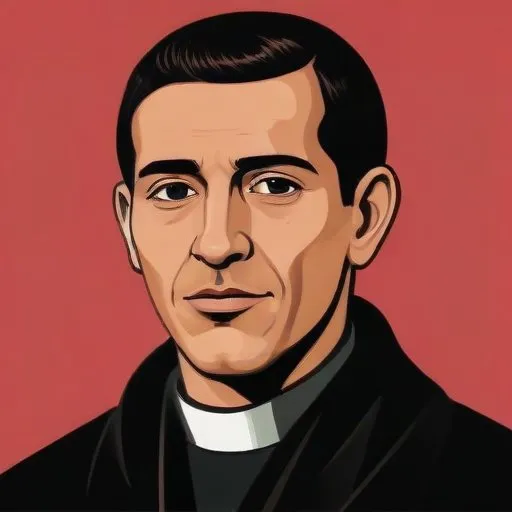
A 17th-century Portuguese Jesuit missionary and martyr who preached Christianity in India and was brutally executed for his faith, inspiring many with his courage and devotion.
John de Brito, a Portuguese Jesuit missionary, is renowned for his unwavering dedication to spreading Christianity in India during the 17th century. Known for his bravery and unrelenting spirit, Brito faced unimaginable challenges, including imprisonment, torture, and ultimately, martyrdom, yet remained resolute in his mission to convert the masses.
Born on March 1, 1647, in Lisbon, Portugal, John de Brito was drawn to the Jesuit order from a young age. He joined the Society of Jesus in 1662 and began his studies in Portugal and Spain. Brito's calling to serve as a missionary in India began to take shape during his novitiate, and he soon set sail for the subcontinent in 1673.
In India, Brito was assigned to the Madurai Mission, where he quickly became fluent in the local language, Tamil. He worked tirelessly to convert the local population, often facing opposition from Hindu and Muslim communities. Brito's fearlessness in the face of adversity earned him the respect of the native people, who began to see him as a champion of the poor and the oppressed.
In 1693, Brito was arrested by the Marava king, who accused him of conspiracy and treason. Despite being subjected to gruesome torture, Brito refused to renounce his faith. He was eventually beheaded on February 4, 1693, in Oriyur, Tamil Nadu, India.
John de Brito's unwavering commitment to his faith and his people inspired countless others to follow in his footsteps. He was beatified in 1820 and canonized in 1947 by Pope Pius XII. Today, Brito is revered as the patron saint of Tamil Nadu, and his feast day is celebrated on February 4.
Brito's missionary work was deeply rooted in his philosophy of love and compassion. He believed that the key to converting the masses lay in understanding and respecting local customs and traditions. This approach earned him the trust and admiration of the people he served.
John de Brito's legacy extends far beyond his missionary work. He is remembered as a champion of social justice, a pioneer in interfaith dialogue, and a symbol of courage in the face of adversity. His story continues to inspire people from all walks of life, reminding us of the importance of standing firm in our beliefs and fighting for what is just.
John de Brito's martyrdom occurred during a time of great turmoil in India, with the Mughal Empire and European colonial powers vying for control. His sacrifice, however, transcended the political and social chaos of his era, leaving behind a lasting legacy that continues to inspire generations.
As we reflect on the life and times of John de Brito, we are reminded of the power of unwavering commitment, courage, and compassion. His story serves as a beacon of hope, inspiring us to stand firm in our beliefs and to fight for justice and equality in our own time.
Born in 1506
Co-founder of the Society of Jesus, a Catholic religious order, known for his missionary work in Asia, especially in India and Japan, and for his role in the Counter-Reformation. He's revered for his tireless efforts to spread Christianity and his compassion for the poor and marginalized.
Born in 1491
Founded the Jesuit Order, a Catholic religious organization known for its missionary and educational work, and developed the Spiritual Exercises, a guide for spiritual growth and discernment.
Born in 1647
A 17th-century Portuguese Jesuit missionary and martyr who preached Christianity in India and was brutally executed for his faith, inspiring many with his courage and devotion.
Born in 1552
A 16th-century Jesuit priest who introduced Western science and Christianity to China, mapping the country and earning the respect of its rulers. He's credited with facilitating cultural exchange between East and West.
