


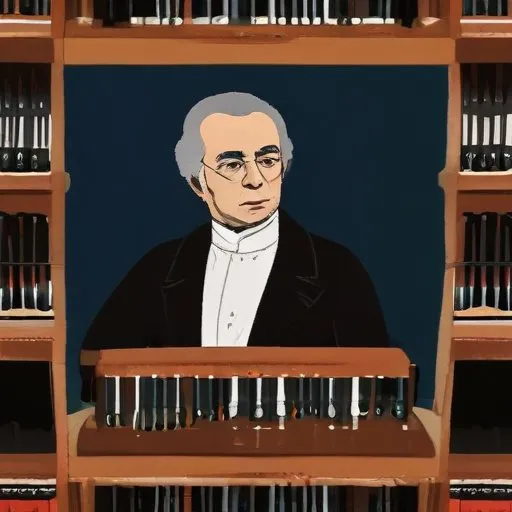
A renowned organist and composer of the Romantic era, known for his contributions to the development of sacred music and his prolific output of over 200 works.
Josef Rheinberger is renowned for his sublime contributions to sacred music, leaving an indelible mark on the world of classical music. As a prolific composer, organist, and court conductor, he crafted a repertoire that echoes through the corridors of time, whispering tales of devotion and spirituality.
Born on March 17, 1839, in Vaduz, Liechtenstein, Rheinberger was destined for greatness. At a mere seven years old, he took his first steps as an organist at the Vaduz parish church, and his first composition was performed the following year. His early prodigy was nurtured by his studies with composer Philipp M. Schmutzer in Feldkirch, Vorarlberg.
In 1851, Rheinberger's father, Johann Peter, finally relented to his son's passion for music, allowing him to enter the Munich Conservatorium. This pivotal decision set the stage for Rheinberger's future successes. Upon graduating, he became a professor of piano and composition at the same institution, where he would later meet his future wife and collaborator, Franziska von Hoffnaass.
Rheinberger's appointment as rptiteur at the Court Theatre in 1867 marked the beginning of his illustrious career in Munich. His marriages to Franziska in the same year not only brought him personal happiness but also led to a fruitful creative partnership. Franziska, a poet and socialite, wrote the texts for many of Rheinberger's vocal works, including his beloved motet, Abendlied.
Rheinberger's sacred music, characterized by its soaring melodies and harmonic richness, is deeply rooted in the traditions of Bach, Schumann, and Mendelssohn. His compositions, including masses, Christmas cantatas, and symphonies, evoke a sense of reverence and awe, transporting listeners to a realm of spiritual contemplation.
Rheinberger's legacy extends far beyond his own lifetime. As a court conductor, responsible for the music in the royal chapel, he played a pivotal role in shaping the musical landscape of Munich. His influences on contemporaries such as Brahms and his contributions to the development of sacred music have left an enduring mark on the classical music world.
Today, Rheinberger's music continues to inspire and uplift audiences around the world. His compositions remain a staple of choral and instrumental repertoire, a testament to the timelessness of his art.
Rheinberger's dedication to his craft and his contributions to the world of music earned him an honorary doctorate in 1877. This prestigious recognition cemented his position as a leading figure in the Munich musical circle.
Rheinberger's life's work is a testament to the transformative power of music, a bridge that connects us to the divine and to each other. As we look back on his remarkable journey, we are reminded of the enduring beauty and significance of sacred music, and the profound impact it has on our lives.
Born in 1811
A virtuosic pianist and composer who revolutionized classical music with his technically demanding and emotionally expressive works, blending Hungarian folk influences with Romantic-era drama.
Born in 1833
A renowned pianist and composer, he crafted complex, expressive works that blended traditional and innovative techniques, leaving an indelible mark on classical music.
Born in 1824
A renowned composer of symphonies and sacred music, known for his complex harmonies and innovative orchestration. His works are considered a bridge between Romanticism and modern classical music.
Born in 1813
A renowned composer of iconic operas like La Traviata and Aida, known for his masterful blending of drama and music. His works continue to captivate audiences worldwide.
Born in 1813
A revolutionary composer who transformed opera with his epic, mythological works, creating a new era of musical storytelling. His iconic operas, such as "Der Ring des Nibelungen," continue to captivate audiences worldwide.
Born in 1809
A renowned 19th-century musician who masterfully blended classical and romantic styles, creating iconic works like the "Wedding March" and "Elijah" oratorio. His compositions continue to inspire and influence generations of artists.
Born in 1810
A renowned Romantic-era composer and influential music critic, known for his expressive and emotionally charged works, including symphonies, piano music, and art songs.
Born in 1819
Austrian composer and conductor renowned for his operettas, particularly "Light Cavalry" and "Poet and Peasant", which remain popular to this day.
