


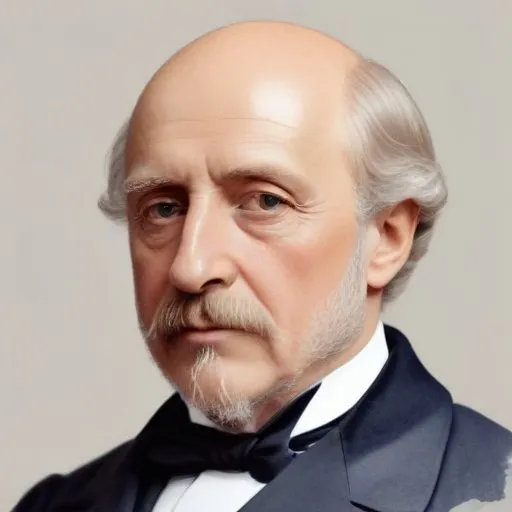
Designed London's sewer system, revolutionizing urban sanitation and saving countless lives from waterborne diseases.
Sir Joseph William Bazalgette is renowned for his groundbreaking work in creating a sewerage system for central London, alleviating the city's notorious "Great Stink" of 1858 and, in the process, eradicating cholera epidemics that had plagued the city for centuries. As Chief Engineer of the Metropolitan Board of Works, Bazalgette's pioneering efforts transformed the city's sanitation infrastructure, earning him a permanent place in the annals of London's history.
Born on March 28, 1819, in Enfield, Middlesex, Bazalgette was the son of a retired Royal Navy captain, Joseph William Bazalgette, and Theresa Philo (née Pilton). His Huguenot grandfather, Louis Bazalgette, had amassed wealth through his ties to the future George IV, setting the family on a path of success. In 1827, the Bazalgettes moved to Hamilton Terrace, St Johns Wood, London, where Joseph spent his formative years.
Bazalgette was articled to the esteemed engineer Sir John Macneill, working on railway projects, and later gained experience in land drainage and reclamation in China and Ireland. This exposure enabled him to establish his own consulting practice in London in 1842. In 1845, Bazalgette married Maria Kough, from County Kilkenny in Ireland, and shortly after, suffered a nervous breakdown in 1847, likely due to the demands of his burgeoning career.
In 1847, the Metropolitan Commission of Sewers ordered the closure of cesspits and mandated house drains connect to sewers, emptying into the Thames. This decisiontriggered a devastating cholera epidemic in 1849, claiming 14,137 lives. Bazalgette's appointment as Assistant Surveyor to the Metropolitan Commission in 1849, and later as Engineer in 1852, marked a crucial turning point in his career. His expertise was instrumental in addressing the city's sanitation crisis, and his subsequent designs revolutionized London's sewerage system.
Bazalgette's sewerage system, which included the construction of over 1,100 miles of sewers and tunnels, effectively removed the city's waste, eradicating cholera epidemics and transforming the River Thames from an open sewer to a relatively clean waterway. His innovative designs earned him recognition, including the title of Chief Engineer of the Metropolitan Board of Works, and later, a knighthood in 1874. Bazalgette's legacy extends beyond his technical achievements, as his work improved the health and well-being of Londoners, shaping the city's future.
Bazalgette's later years were marked by continued public service, including his involvement in the design of London's major thoroughfares. He passed away on March 15, 1891, at the age of 71, leaving behind a lasting legacy that continues to impact London's infrastructure and public health to this day.
Born in 1806
A visionary engineer who revolutionized transportation with innovative designs, including the iconic Clifton Suspension Bridge, which transformed urban landscapes.
Born in 1803
Designed iconic bridges and locomotives that transformed 19th-century transportation, leaving a lasting legacy in the development of modern railways.
Born in 1781
Designed the Liverpool and Manchester Railway, a pioneering feat that revolutionized transportation and paved the way for modern rail networks.
Born in 1791
Pioneering scientist who discovered electromagnetic induction, formulated the laws of electrolysis, and invented the first electrical generator, revolutionizing our understanding of electricity and its applications.
Born in 1791
A pioneer in computer science, credited with inventing the first mechanical computer, the Difference Engine, and conceptualizing the Analytical Engine, a precursor to modern computers.
Born in 1815
Pioneering mathematician and computer scientist who wrote the first algorithm intended to be processed by a machine, and is often considered the first computer programmer. Her work on Charles Babbage's Analytical Engine envisioned its potential to go beyond mere calculation and perform any task that could be expressed in a series of steps.
Born in 1792
Developed a system of mathematical astronomy, cataloging over 2,500 nebulae and star clusters, and made significant contributions to the field of photography. His work laid the foundation for modern astronomy and astrophysics.
