


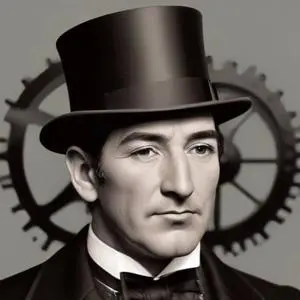
Designed iconic bridges and locomotives that transformed 19th-century transportation, leaving a lasting legacy in the development of modern railways.
Robert Stephenson, the only son of George Stephenson, the "Father of Railways," is renowned for his groundbreaking contributions to the development of locomotives and civil engineering. As a pioneering engineer, he not only built upon his father's achievements but also left an indelible mark on the 19th century.
Born on October 16, 1803, at Willington Quay, east of Newcastle upon Tyne, Robert's life was shaped by his father's passion for engineering. After his mother Fanny's passing in 1806, George Stephenson ensured that his son received a formal education, recognizing its importance in achieving success.
Robert attended the Percy Street Academy in Newcastle, where he developed a strong foundation in mathematics and science. He was an avid member of the Newcastle Literary and Philosophical Society, borrowing books to fuel his curiosity and working alongside his father on steam engine designs in the evenings.
Stephenson's apprenticeship under Nicholas Wood, manager of Killingworth colliery, laid the groundwork for his future triumphs. He worked diligently, creating a homemade mining compass when he couldn't afford to buy one. This resourcefulness would later serve him well in surveying the High Level Bridge in Newcastle.
Some of Robert's most notable achievements include:
Robert Stephenson's contributions had far-reaching consequences, revolutionizing transportation and transforming the way people lived and worked. His innovative designs and engineering prowess:
In recognition of his outstanding achievements, Robert Stephenson was:
Stephenson's life was marked by significant milestones, including:
Robert Stephenson's legacy extends beyond his impressive body of work. He:
As one of the greatest engineers of the 19th century, Robert Stephenson's vision, creativity, and perseverance continue to inspire and influence the world we live in today.
Born in 1806
A visionary engineer who revolutionized transportation with innovative designs, including the iconic Clifton Suspension Bridge, which transformed urban landscapes.
Born in 1781
Designed the Liverpool and Manchester Railway, a pioneering feat that revolutionized transportation and paved the way for modern rail networks.
Born in 1791
Pioneering scientist who discovered electromagnetic induction, formulated the laws of electrolysis, and invented the first electrical generator, revolutionizing our understanding of electricity and its applications.
Born in 1791
A pioneer in computer science, credited with inventing the first mechanical computer, the Difference Engine, and conceptualizing the Analytical Engine, a precursor to modern computers.
Born in 1815
Pioneering mathematician and computer scientist who wrote the first algorithm intended to be processed by a machine, and is often considered the first computer programmer. Her work on Charles Babbage's Analytical Engine envisioned its potential to go beyond mere calculation and perform any task that could be expressed in a series of steps.
Born in 1771
Built steam-powered locomotives, revolutionizing land transportation, and pioneered the use of steam engines in mines.
Born in 1736
Improved steam engine efficiency, revolutionizing industry and transportation. Known for his innovative designs and patents that transformed the Industrial Revolution.
Born in 1771
Developed precision engineering techniques and invented the screw-cutting lathe, revolutionizing manufacturing and enabling mass production.
