


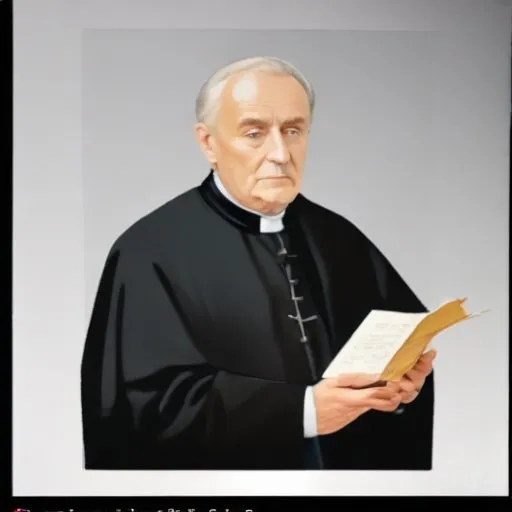
A French priest and composer who wrote liturgical music, particularly Gregorian chant, and is credited with modernizing sacred music. His work remains influential in Catholic worship today.
Joseph Gelineau, a French Jesuit priest and composer, is renowned for his remarkable contributions to modern Christian liturgical music. His innovative approach to psalmody, which has been adopted worldwide, has made him a legendary figure in the realm of sacred music.
Born on October 31, 1920, in Champs-sur-Layon, Maine-et-Loire, France, Gelineau's journey began with his entry into the Society of Jesus in 1941. He pursued his studies in Catholic theology in Lyon and music in Paris, laying the foundation for his future endeavors.
Deeply influenced by Gregorian chant, Gelineau developed his signature psalmody style, which has become a hallmark of modern Christian liturgical music. His psalm tones, designed to express the asymmetrical, three to four-line design of the psalm texts, have been widely acclaimed and adopted globally.
Gelineau collaborated with Dominican Raymond Jacques Tournay and R. Schwab to rework the Jerusalem Bible Psalter, resulting in the critically acclaimed Psaumes de la Bible de Jérusalem, which won the prestigious Grand Prix de L'Académie Charles Cros in 1953.
He also composed numerous chants for the ecumenical French Taizé Community, further solidifying his reputation as a master composer of sacred music.
Gelineau's contributions to modern Christian liturgical music have been far-reaching and profound. His innovative approach has inspired generations of composers, musicians, and worship leaders, shaping the sound of contemporary Christian music.
Joseph Gelineau's legacy extends beyond his compositions to the countless lives he touched through his music. His dedication to his craft and his faith has left an indelible mark on the world of sacred music.
Today, his music continues to inspire and uplift people of all faiths, a testament to the power of music to transcend boundaries and unite humanity.
As we remember the life and legacy of Joseph Gelineau, we are reminded of the transformative power of music to inspire, to uplift, and to bring people together in celebration of the divine.
Born in 1907
A renowned French organist and composer, he was a master of improvisation and wrote numerous works for the organ, blending traditional and modern styles. His music continues to inspire and influence organists worldwide.
Born in 1908
A French composer and ornithologist who merged birdsong with avant-garde music, creating a unique and influential sound. His work continues to inspire musicians and bird enthusiasts alike.
Born in 1902
A renowned French organist and composer, famous for his mesmerizing and intricate Requiem Mass, which is still widely performed and admired today.
Born in 1924
A renowned French organist and composer, he was a master of improvisation and created numerous works for the organ, earning him a reputation as one of the most innovative and influential organists of the 20th century.
Born in 1926
A French cardinal who served as Archbishop of Paris and was a prominent figure in the Catholic Church, known for his efforts to improve Jewish-Catholic relations.
Born in 1550
The pope who condemned Galileo's heliocentric theory and established the Immaculate Conception as Catholic dogma, shaping the Church's stance on science and theology.
