


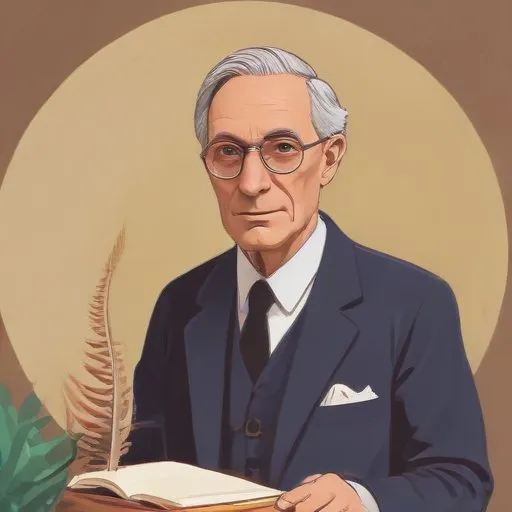
Pioneering paleontologist who discovered and named numerous dinosaur species, significantly advancing the field of vertebrate paleontology.
Joseph Leidy, a prominent American paleontologist, parasitologist, and anatomist, left an indelible mark on the scientific community with his groundbreaking contributions to the field of natural history. He is particularly renowned for his meticulous work on fossilized skeletons, including the discovery of the nearly complete dinosaur fossil, Hadrosaurus foulkii.
Born on September 9, 1823, to a Pennsylvania German family in Philadelphia, Leidy's early life was marked by tragedy with the loss of his mother at childbirth. Despite his father's initial disapproval, Leidy pursued a career in medicine, graduating from the University of Pennsylvania in 1844. His stepmother, Christiana Mellick, played a significant role in supporting his educational endeavors.
Leidy's illustrious career spanned across prominent institutions, including the University of Pennsylvania, where he held the position of professor of anatomy, and later, Swarthmore College, where he became a professor of natural history. He also served as the director of scientific and educational programs at the Wagner Free Institute of Science.
In 1869, Leidy published his seminal work, Extinct Fauna of Dakota and Nebraska, which cataloged numerous species previously unknown to the scientific community. This comprehensive volume cemented his reputation as a leading authority in paleontology and fossil research.
Leidy's most significant contribution to paleontology was the naming of the holotype specimen of Hadrosaurus foulkii, a nearly complete fossilized skeleton discovered in Haddonfield, New Jersey. This discovery revolutionized the field, offering valuable insights into the anatomy and evolution of dinosaurs.
In recognition of his remarkable contributions to science, the Leidy Glacier in northwest Greenland was named after him by Robert Peary.
Leidy's work was marked by a commitment to meticulous observation and a passion for understanding the natural world. He believed in the importance of scientific investigation, advocating for the exploration of the natural world to advance human knowledge.
Leidy married Anna Harden, a woman who shared his passion for science and actively supported his work. The couple adopted a young orphan, Alwinia, and had a close relationship with her. Leidy's brother, Thomas, was also a significant figure in his life.
In 1848, Leidy was elected a member of the American Philosophical Society, a testament to his esteemed position within the scientific community.
Born in 1834
A German biologist, physician, and philosopher who coined the term "ecology" and made significant contributions to the field of evolutionary biology, including the recapitulation theory.
Born in 1809
Developed the theory of evolution through natural selection, revolutionizing our understanding of life on Earth. This groundbreaking idea transformed the fields of biology, ecology, and beyond.
Born in 1823
A pioneering naturalist who discovered evolution through natural selection, independently of Charles Darwin, and contributed significantly to the field of biogeography.
Born in 1744
A French soldier, biologist, and academic who developed a theory of inheritance of acquired characteristics, proposing that organisms adapt to their environment and pass on those traits to their offspring.
Born in 1902
A renowned paleontologist and author who revolutionized the field of evolutionary biology with his groundbreaking work on fossil records and species adaptation. His contributions significantly shaped modern understanding of life on Earth.
Born in 1900
A pioneer in evolutionary biology, he integrated genetics and evolution, revolutionizing our understanding of species adaptation and diversity. His work laid the foundation for modern evolutionary theory.
