


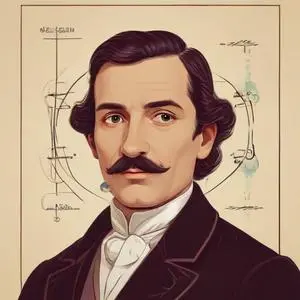
French physicist and chemist who formulated the law of combining volumes and discovered the elements boron and iodine, making significant contributions to the field of chemistry.
Meet Joseph Louis Gay-Lussac, the French chemist and physicist who revolutionized our understanding of gases, liquids, and the art of mixology. He is best known for his groundbreaking discoveries that water is comprised of two parts hydrogen and one part oxygen by volume, and for his two laws related to gases, which have had a profound impact on various fields, including chemistry, physics, and even the production of fine spirits.
Born on December 6, 1778, in Saint-Léonard-de-Noblat, Haute-Vienne, France, Gay-Lussac's early life was marked by turmoil. His father, Anthony Gay, a lawyer and prosecutor, was imprisoned during the French Revolution, and the young Gay-Lussac received his education at the hands of the Catholic Abbey of Bourdeix. Later, he moved to Paris, where he entered the École Polytechnique in 1798 and eventually transferred to the École des Ponts et Chaussées.
In 1804, Gay-Lussac became an assistant to the renowned chemist Claude-Louis Berthollet, which marked the beginning of his illustrious career. He soon succeeded Antoine-François Fourcroy as a professor of chemistry at the École Polytechnique and later became a professor of physics at the Sorbonne. His academic prowess earned him numerous accolades, including election as a foreign member of the Royal Swedish Academy of Sciences in 1821.
Gay-Lussac's most significant contributions to science are his two laws related to gases. The first law, known as Gay-Lussac's Law of Combining Volumes, states that gases react in simple whole number ratios by volume. The second law, Gay-Lussac's Law of Expansion, describes the relationship between the pressure and temperature of a gas. These laws have far-reaching implications in fields such as chemistry, physics, and engineering.
Gay-Lussac's work on alcohol-water mixtures led to the development of the degrees Gay-Lussac, a system used to measure the alcoholic strength of beverages in many countries. This innovation has had a lasting impact on the production and regulation of spirits, solidifying Gay-Lussac's place as a pioneer in the world of mixology.
Throughout his life, Gay-Lussac held various esteemed positions, including professorships, memberships in prestigious scientific academies, and even a seat in the French Chamber of Deputies. His contributions to science and education have inspired generations of researchers and scholars. Today, his work remains a cornerstone of modern chemistry and physics, a testament to his enduring legacy as a master of gases and spirits.
As we raise a glass to Joseph Louis Gay-Lussac, we honor not only his groundbreaking discoveries but also his unwavering commitment to the pursuit of knowledge and his enduring impact on our understanding of the world around us.
Born in 1743
Father of modern chemistry, discovered oxygen, and developed a systematic method of chemical nomenclature. He laid the foundation for modern chemistry and paved the way for future scientific discoveries.
Born in 1749
Developed nebular hypothesis of the origin of the solar system and formulated Laplace's equation, a fundamental concept in mathematics and physics. He's considered the founder of celestial mechanics.
Born in 1744
A French soldier, biologist, and academic who developed a theory of inheritance of acquired characteristics, proposing that organisms adapt to their environment and pass on those traits to their offspring.
Born in 1769
Founded the field of comparative anatomy, establishing extinction as a fact and creating a framework for understanding the natural world through fossil records.
Born in 1778
Pioneering chemist and physicist who discovered several elements, including potassium and sodium, and invented the Davy lamp, a safety lamp for miners. His groundbreaking work laid the foundation for modern chemistry and electrochemistry.
83 Years Old
A British bassist who played with bands like The Levellers and Faithless, known for his energetic stage presence and distinctive bass lines.
Born in 1776
Formulated the molecular hypothesis, which states that equal volumes of gases at the same temperature and pressure contain an equal number of molecules. This concept is fundamental to understanding chemistry and physics.
Born in 1791
Pioneering scientist who discovered electromagnetic induction, formulated the laws of electrolysis, and invented the first electrical generator, revolutionizing our understanding of electricity and its applications.
