


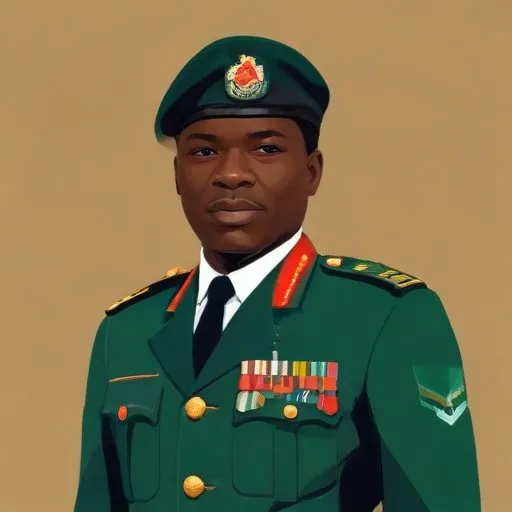
A Sierra Leonean soldier and politician who served as the 2nd President of Sierra Leone from 1985 to 1992, known for his military background and authoritarian rule.
Joseph Saidu Momoh, a prominent figure in Sierra Leonean politics, served as the country's second President from 1985 to 1992, leaving an indelible mark on the nation's history. He is remembered for his efforts to combat corruption and introduce a multiparty system, as well as his tumultuous struggle against the Revolutionary United Front (RUF) rebel group.
Born on January 26, 1937, in Binkolo, Bombali District, Momoh hailed from the Limba ethnic group. His family later moved to Freetown, where he received his education at the West African Methodist Collegiate School from 1951 to 1955. Momoh's athletic prowess was evident in his love for sports, particularly tennis, basketball, volleyball, and football.
In 1956, Momoh embarked on a military career, which would eventually propel him to the highest echelons of power. He rose through the ranks, becoming Force Commander in 1971 and later, Major General in 1983. His political career took off when he was appointed Secretary General of the All People's Congress (APC), the country's sole legal party, in 1985.
Following the retirement of President Siaka Stevens in 1985, Momoh became the sole candidate in the presidential election and succeeded Stevens as President. He inherited a struggling economy, but made significant strides in combating corruption. Momoh's foreign policy saw him cultivate positive relationships with the United States and the United Kingdom.
In 1991, the RUF rebel group launched a brutal insurgency aimed at overthrowing Momoh's government. In response, he introduced a new constitution, allowing for a multiparty system. However, this move was not enough to prevent his eventual ousting in a coup d'état led by Valentine Strasser in 1992.
Fleeing to Guinea, Momoh lived in exile until his death on August 3, 2003, just a year after the end of the Sierra Leone Civil War. Despite his tumultuous tenure, Momoh's efforts to combat corruption and introduce democratic reforms remain significant contributions to Sierra Leone's development.
Joseph Saidu Momoh's complex legacy serves as a testament to the challenges faced by Sierra Leone during its turbulent transition to democracy. His story is a reminder of the importance of strong leadership, democratic reforms, and the enduring struggle for peace and stability in West Africa.
Born in 1905
First President of Sierra Leone, leading the country from 1971 to 1985 and implementing a one-party system. He's known for his authoritarian rule and human rights abuses.
Born in 1904
First President of Nigeria, leading the country to independence from British colonial rule and shaping its early years as a sovereign nation.
Born in 1909
A Nigerian lawyer and politician who played a key role in the country's independence movement and was a strong advocate for democracy and education. He's also known for his efforts to develop Nigeria's economy and infrastructure.
Born in 1909
First President of Ghana, leading the country to independence from British colonial rule and promoting Pan-Africanism. He's known for his vision of a united Africa and his role in shaping modern Ghana.
Born in 1922
First President of Tanzania, led the country to independence from British colonial rule and implemented socialist policies, known for his Pan-Africanism and anti-colonialism efforts.
