


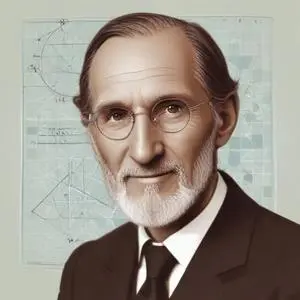
Developed the theory of thermodynamics and introduced the concept of free energy, revolutionizing the field of chemistry and physics.
Josiah Willard Gibbs, a renowned American scientist, revolutionized the fields of physics, chemistry, and mathematics with his groundbreaking contributions to statistical mechanics. His work transformed physical chemistry into a rigorous deductive science, paving the way for a deeper understanding of thermodynamics.
Born on February 11, 1839, in New Haven, Connecticut, Gibbs grew up in an academic family. His father, Josiah Willard Gibbs Sr., was a professor of sacred literature at Yale University, and his mother, Mary Anna Van Cleve, was a descendant of a prominent American family.
Gibbs' early education took place at the Hopkins School in New Haven, where he demonstrated exceptional talent in mathematics. He later attended Yale University, graduating in 1858 with a degree in mathematics. In 1863, Yale awarded Gibbs the first American doctorate in engineering, marking the beginning of his illustrious career.
Gibbs' most significant achievement was the development of statistical mechanics, a term he coined. This branch of science explains the laws of thermodynamics as consequences of the statistical properties of ensembles of possible states of a physical system composed of many particles. His work built upon the theories of James Clerk Maxwell and Ludwig Boltzmann, cementing his place alongside these giants of physics.
In addition to his work on statistical mechanics, Gibbs made significant contributions to:
In 1901, Gibbs received the Copley Medal from the Royal Society of London, considered the highest honor in the scientific community at the time. This recognition acknowledged his outstanding contributions to mathematical physics and solidified his position as a leading figure in the field.
Gibbs' work, although largely theoretical, had a profound impact on the development of industrial chemistry in the 20th century. His ideas and equations continue to influence fields such as:
Despite his monumental achievements, Gibbs led a relatively quiet and solitary life. He never married and had few close relationships, preferring to focus on his work.
Some interesting facts about Gibbs include:
Josiah Willard Gibbs' groundbreaking contributions to statistical mechanics, thermodynamics, and vector calculus have left an indelible mark on the scientific community. His remarkable mind and dedication to his work have inspired generations of scientists, and his legacy continues to shape our understanding of the world around us.
Born in 1831
Developed groundbreaking theories that unified electricity and magnetism, and predicted the existence of radio waves, revolutionizing our understanding of the physical world.
Born in 1844
Developed the theory of statistical mechanics, which explains the behavior of gases and is a fundamental concept in modern physics.
Born in 1822
Developed the theory of thermodynamics, introducing the concept of entropy, and made significant contributions to the fields of electricity and magnetism.
Born in 1821
A 19th-century physician and physicist who made significant contributions to the fields of electromagnetism, thermodynamics, and the physiology of human perception, particularly in the study of vision and hearing.
Born in 1749
Developed nebular hypothesis of the origin of the solar system and formulated Laplace's equation, a fundamental concept in mathematics and physics. He's considered the founder of celestial mechanics.
Born in 1879
A brilliant physicist who developed the theory of relativity and is considered one of the most influential scientists of the 20th century, known for his groundbreaking work in physics and mathematics.
